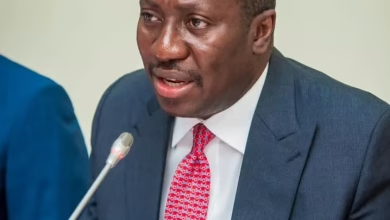
Ghana’s Women’s Development Bank Heading to Cabinet- Mahama Moves to Make It the Cabinet
President Mahama announces that Vice President Jane Naana Opoku-Agyemang will table the formal resolution on the Women's Development Bank at the next Cabinet meeting — a major step toward delivering dedicated financial power to Ghana's market women and female entrepreneurs.

By: Ebenezer Adu-Gyamfi / Emmanuel AyikuFor GhanaianNewsCanada | May 24, 2026 | Accra / Toronto
ACCRA / TORONTO — One of the most anticipated promises of the Mahama administration is finally moving toward formal government approval. President John Dramani Mahama announced on Saturday May 23, 2026, that Vice President Jane Naana Opoku-Agyemang will table a resolution on the proposed Women’s Development Bank at the next Cabinet meeting — signalling that the specialised financial institution, long championed as a transformative policy for Ghana’s women, is now entering its critical implementation phase.
Speaking during a citizens’ engagement at Ndewura Jakpa Senior High School in the Savannah Region, Mahama told the audience: “Work is progressing very fast. Indeed, at the next Cabinet meeting, the Vice President is supposed to table the resolution on the Women’s Development Bank. She will be giving a Cabinet report on the Women’s Development Bank.” The announcement was met with visible enthusiasm — particularly in a region where women traders and smallholder farmers have long struggled to access formal credit.
What Is the Women’s Development Bank?
The Women’s Development Bank is a flagship NDC campaign promise — a dedicated financial institution specifically designed to provide affordable credit, savings products, business development services, and financial literacy support to women across Ghana. Its primary focus is on those who have historically been most excluded from formal banking: market women, petty traders, small-scale farmers, artisans, and women-led micro and small enterprises.
The concept is not new — similar institutions exist in other developing economies and have produced measurable improvements in women’s economic participation and household income levels. The idea behind the bank is that when you give women dedicated, accessible, and affordable financial tools, the benefits ripple outward: into families, into communities, into local economies. President Mahama and Vice President Opoku-Agyemang — herself a former Education Minister and one of Ghana’s most high-profile female public figures — have both publicly committed to making this bank a reality.
Why It Has Taken Time — Mahama Explains
Mahama was candid with his audience about why the bank has not yet been launched, despite being a central promise of the NDC’s 2024 election campaign. “The thing is, for financial institutions, you don’t just get up and set up a bank,” he explained. “The Bank of Ghana has its own requirements. You need to meet the capital requirements, you need to go through the licensing process, and you need to set up the regulatory framework.”
The President’s explanation reflects a genuine institutional reality. Establishing a licensed bank in Ghana requires a minimum paid-up capital, a viable business plan, regulatory approval from the Bank of Ghana, and a governance structure that satisfies the requirements of the Banks and Specialized Deposit-Taking Institutions Act.
These are not formalities that can be bypassed — they exist to protect depositors and ensure the stability of the financial system. Mahama’s message was clear: the government is moving as fast as the regulatory framework allows, and the Cabinet presentation by Opoku-Agyemang is the next concrete step.
Jane Naana Opoku-Agyemang: The Champion Behind the Bank
The choice of Vice President Jane Naana Opoku-Agyemang as the person to shepherd this proposal through Cabinet is not accidental. Opoku-Agyemang — Ghana’s first female Vice President, a former Minister of Education, and a former Vice Chancellor of the University of Cape Coast — has made women’s economic empowerment a central theme of her public career.
She has spoken repeatedly about the structural barriers that prevent Ghanaian women from accessing financial services and the transformative potential of dedicated institutional support.
Her role as the Cabinet champion of the Women’s Development Bank sends a signal beyond the policy itself: that Ghana’s first female Vice President is personally invested in ensuring that the financial institution designed to serve women is delivered with the same rigour and commitment that she has brought to every position she has held.
For Ghana’s women — who make up more than half the population and a disproportionate share of the informal economy — that is a meaningful assurance.
Why This Matters for Ghanaian Women in Canada
For Ghanaian-Canadian women watching this development from Toronto, Calgary, Ottawa, and beyond, the Women’s Development Bank carries significance on two levels. On a personal level, many Ghanaian-Canadian women have mothers, sisters, aunts, and friends back home who are exactly the market women and small-scale traders this bank is designed to serve.
The prospect of a dedicated institution that provides affordable credit to those women — rather than leaving them at the mercy of informal money lenders charging exploitative interest rates — is genuinely exciting.
On a broader level, the establishment of the Women’s Development Bank is part of a pattern of policy direction that suggests the Mahama administration is serious about the kind of structural economic transformation that could make Ghana a more viable long-term destination for diaspora investment and return migration.
A country that systematically empowers its women economically is a country that is building the kind of stable, inclusive, and productive domestic economy that attracts diaspora Ghanaians back — not just to visit, but to invest, to start businesses, and to come home.