June 3 Disaster: Remembering the Day Floodwaters and Fire Claimed Hundreds of Lives in Accra
On the night of June 3, 2015, over 150 Ghanaians lost their lives in a catastrophic combination of flood and fire at the GOIL fuel station near Kwame Nkrumah Circle in Accra. Eleven years later, the wounds are still open — and the questions about Ghana's preparedness remain unanswered.
By: Ebenezer Adu-Gyamfi / Emmanuel Ayiku For GhanaianNewsCanada | June 3, 2026 | Accra / Toronto

ACCRA / TORONTO — Today, June 3, 2026, Ghana pauses. It has been eleven years since the most catastrophic single night in the country’s modern history — a night when nature turned brutal, human negligence turned deadly, and the heart of Accra became a scene of unimaginable loss. The June 3, 2015 Flood and Fuel Station Disaster at Kwame Nkrumah Circle claimed over 150 lives, injured hundreds more, and left scars — physical, psychological, and national — that have never fully healed.
For many Ghanaians at home and in the diaspora, June 3 is not just a date on a calendar. It is a wound. It is the memory of a phone call received in the middle of the night, a name read in a newspaper list of the dead, a face that should still be alive. For the Ghanaian-Canadian community — many of whom had family members, friends, or colleagues in Accra on that night — it remains one of those events that divides life into before and after.
This is the story of what happened that night. And this is the story of what has — and has not — changed in the eleven years since.
The Days Before — Rains That Would Not Stop
The disaster did not begin on June 3. It began two days earlier. Torrential rains had been hammering Accra since June 1, 2015 — the kind of sustained, relentless downpour that overwhelms drainage systems, turns roads into rivers, and makes the daily business of life in the city impossible. Accra’s infrastructure, weakened by years of neglect, blocked drainage channels, construction on waterways, and rapid unplanned urban growth, was simply not built to handle what nature was sending.
By the evening of June 3, floodwaters had inundated large parts of the capital. The Odaw River — which runs through the heart of Accra and which had not been adequately dredged or maintained — had burst its banks. Streets around Kwame Nkrumah Circle, one of Accra’s busiest and most central junctions, were submerged. Traffic had ground to a halt. Thousands of people — drivers, passengers, traders, workers trying to get home — were stranded across the city as darkness fell and the rain continued to pour.
The Shelter That Became a Death Trap
In the logic of a flooding city at night, a covered fuel station seems like a reasonable place to seek shelter. That is exactly what hundreds of people thought on the evening of June 3. The GOIL fuel station near the Kwame Nkrumah Interchange — a large, state-owned petroleum company’s station in the centre of the city — became a gathering point for people trying to wait out the rain. Drivers pulled their vehicles under the canopy. Passengers clustered under the roof. Pedestrians crowded in from the flooded streets. Buses and private cars packed the forecourt.
What none of them could see — what none of them could have been expected to see in the darkness of a flood and a power outage — was what was floating on the surface of the water around them. Fuel. The floodwaters had caused fuel to overflow from the station’s tanks and storage systems, spreading across the station’s forecourt and into the surrounding flood. The water that people were standing in, that their vehicles were parked in, was laced with petroleum.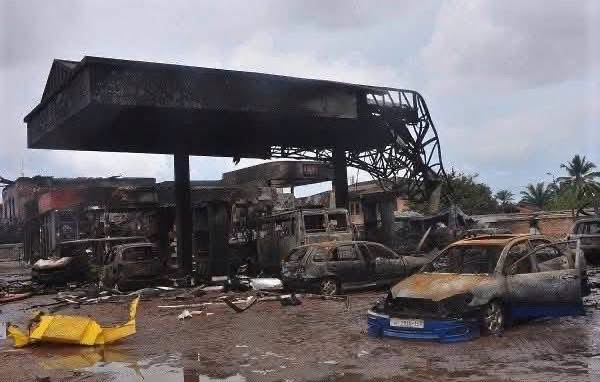
Then came the spark.
The Explosion — A Single Moment That Changed Everything
The government investigation that followed the disaster concluded that the fire was triggered when an individual dropped a lit cigarette into the floodwater. The man, identified in the investigation report as Seth Kwesi Ofosu, dropped the burning stub — whether knowingly or unknowingly — into water that was saturated with fuel. The result was instantaneous and catastrophic. The fuel on the surface of the water ignited. The fire raced across the flooded forecourt. The fuel station’s tanks exploded.
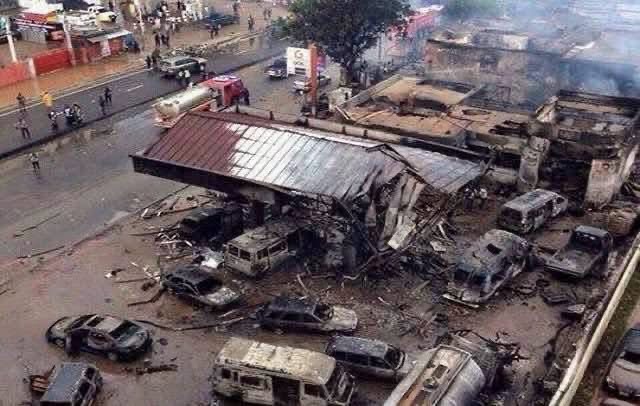
Survivor accounts describe it as something out of a nightmare. One moment there was a crowd of people sheltering from rain. The next, the world was on fire. People who had been standing in what they thought was floodwater found themselves surrounded by flames. There was nowhere to run. The fire spread faster than human instinct could respond. Cars and buses caught alight within seconds. The canopy of the fuel station collapsed. The explosion sent shockwaves through the surrounding buildings.
One survivor, speaking years later, described hearing a single “pop” after the power came back on — and then an eruption of flame that engulfed everything around him. “I still am not fully recovered,” another survivor, Kassim Salam, told journalists nine years after the disaster. “I live in fear whenever it rains or threatens to rain.” The psychological scars of those seconds — the seconds when fire met flood at the worst possible moment — have never left the people who experienced them.
The Aftermath — Bodies in the Drains, a Nation in Mourning
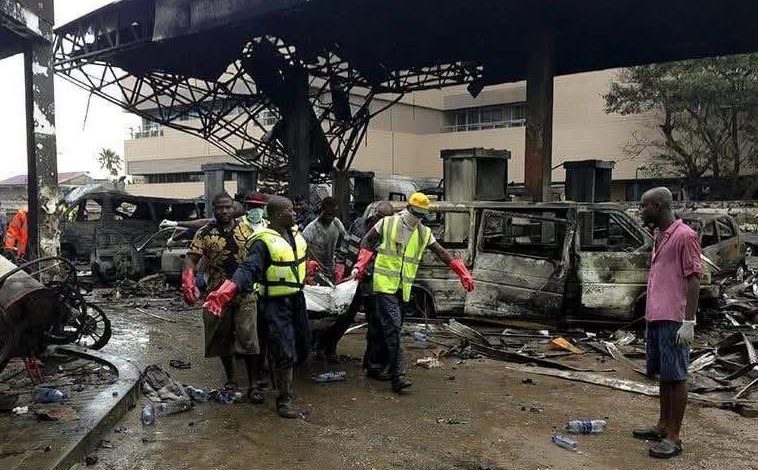
When dawn broke on June 4, 2015, the scale of the horror became visible. The aftermath was grim — bodies were scattered across the streets, and some were found days later in open drains. Emergency responders worked for weeks to clear the devastation. The 37 Military Hospital, Korle Bu Teaching Hospital, and other medical facilities across Accra were overwhelmed with the burned and the injured.
The official death toll confirmed by the government investigation was 154 people — with another 154 people injured, many of them suffering severe burns across large portions of their bodies. Some accounts put the total death toll higher — with figures of over 200 and in some reports over 250 cited, depending on how victims who died in hospital days and weeks after the disaster were counted. Regardless of the precise number, what is not in dispute is the magnitude of the loss: over a hundred families woke up that morning without a mother, a father, a child, a sibling.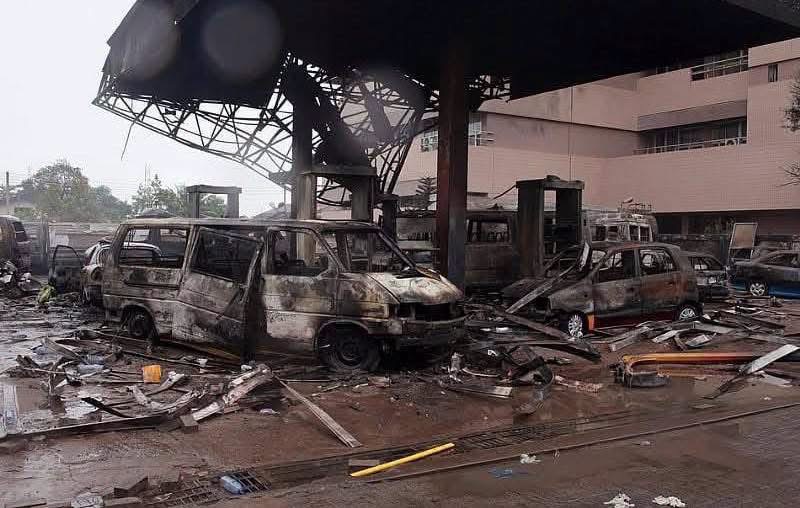
President John Dramani Mahama — who was serving his first term as president at the time — declared three days of national mourning. He visited the scene and addressed the nation. The government set up a committee of inquiry under Justice Isaac Delali Douse to investigate the causes and make recommendations. In the weeks that followed, Ghana grieved collectively in a way it rarely had before — across regional, religious, and political lines, united by the shared shock of what had happened at the heart of its capital city.
What the Investigation Found — A Chain of Failures
The Douse Committee report was careful, thorough, and damning in its own quiet way. It identified the disaster not as a single event with a single cause but as the product of a chain of failures — failures of infrastructure, failures of planning, failures of maintenance, and yes, one fateful human action.
The report’s framework was layered: the flooding of Kwame Nkrumah Circle was the “remote cause” of the fire — a product of Accra’s chronic drainage failures, the blocked and poorly maintained Odaw River system, construction on waterways, and years of inadequate urban planning. The overflow of fuel from the GOIL station was the “intermediate cause” — a technical failure that allowed petroleum to enter the floodwater. And the lit cigarette dropped by Seth Kwesi Ofosu was the immediate spark that converted a dangerous situation into a catastrophe.
The committee’s recommendations were extensive: dredge and desilt the Odaw River and its tributaries; enforce building regulations that prevent construction on waterways; improve drainage infrastructure across Accra; establish emergency response protocols for fuel stations in flood-prone areas; and invest in long-term urban planning that addresses the structural vulnerabilities the disaster had exposed. Every one of those recommendations was reasonable. Every one of them was necessary. And in the years since, Ghana has implemented some of them — but not enough.
The Survivors — Still Waiting for Justice and Recovery
Eleven years after the disaster, the survivors of June 3 are perhaps the most powerful testimony to how much remains undone. A decade after this tragic incident, families of both the deceased and surviving victims are still reeling in pain, struggling to erase the memories and scars of that unfortunate night. For the survivors, life after the disaster has been a difficult battle characterised by neglect, poverty, and exclusion, owing to their inability to return to their previous jobs and lead normal lives.
Survivor Kasim Suraj described still enduring the painful consequences of that night years later. His burns required extensive medical treatment. His ability to work was compromised for years. The compensation and support systems that were promised in the immediate aftermath of the disaster never fully materialised for many survivors. They were left to navigate recovery largely on their own — with the physical scars of burns, the psychological trauma of what they witnessed, and the economic devastation of lost income and destroyed livelihoods.
Eleven Years Later — Has Ghana Learned?
The honest answer is: partly. Some significant infrastructure work has been done on the Odaw River drainage system. Some improvements have been made to Accra’s storm drain network. Awareness of the dangers of sheltering at fuel stations during floods has increased. Emergency response capacity has been strengthened.
But as the post marking the 11th anniversary notes — and as the flooding that hit parts of Accra just last week confirmed — the fundamental challenge is far from solved. Drainage systems remain inadequate. Buildings continue to be constructed on waterways. Waste disposal practices continue to block channels. Urban growth continues to outpace infrastructure planning. Every rainy season, Ghana holds its breath and hopes that this year, the rains will not overwhelm the city the way they did on June 3, 2015.
The challenge is not purely governmental. As Ameyaw Debrah noted in his anniversary post that prompted this remembrance: “Beyond government action, citizens also have a role to play in protecting our environment and keeping drainage channels free from waste.” The June 3 disaster was the product of structural failures — but those structures are maintained, or neglected, by people. By all of us.
A Message to the Ghanaian Diaspora — Remember and Act
For Ghanaian-Canadians marking this anniversary from Toronto, Ottawa, Calgary, and Vancouver, June 3 is a day of remembrance — but it can also be a day of action. The diaspora’s investment in Ghana is not limited to remittances and business ventures. It includes advocacy: pushing for the kind of governance reforms, infrastructure investment, and urban planning accountability that would prevent another June 3 from happening.
The over 150 people who died at Kwame Nkrumah Circle on the night of June 3, 2015 did not die because of a storm. They died because of decades of deferred maintenance, neglected drainage, poor urban planning, and the accumulation of small failures that turned a rainy night into a national tragedy. Honouring their memory means more than lighting candles on an anniversary. It means demanding that Ghana does better — and holding those in power accountable when it does not.