‘Refund Stolen Funds or Go to Nsawam Prison’ — Mahama Drops Bombshell Warning at London Diaspora Town Hall
Speaking before hundreds of Ghanaians in London on Sunday evening, President Mahama issued his toughest anti-corruption warning yet — threatening jail for audit offenders, firing SOE bosses who miss financial reporting deadlines, and defending Ghana's right to attract migrants with a powerful message about human mobility.
By: Ebenezer Adu-Gyamfi / Emmanuel Ayiku For GhanaianNewsCanada | June 1, 2026 | London / Accra / Toronto
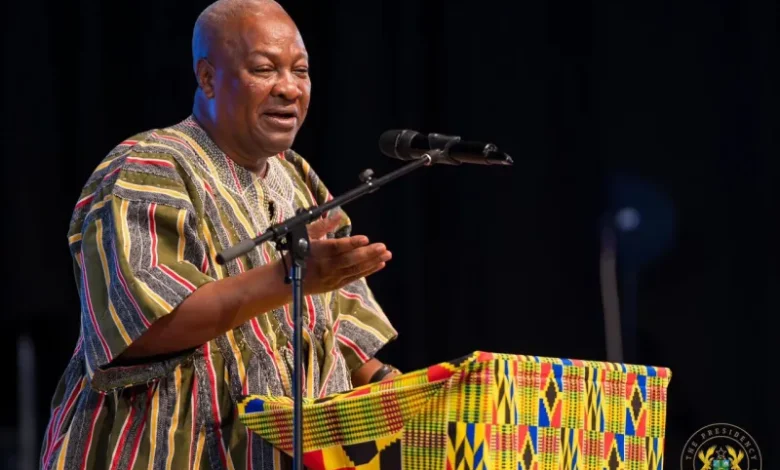
LONDON / TORONTO — When President John Dramani Mahama walked into the Ghana Diaspora Town Hall Meeting in London on Sunday evening, the crowd of Ghanaians gathered at the event — professionals, investors, students, community leaders, and ordinary families — came expecting their president. What they got was something more: a leader who spoke with unusual candour, unusual force, and an unusual willingness to name Ghana’s problems directly and attach real consequences to those responsible.
The town hall, hosted by Ghana’s High Commissioner to the United Kingdom and Ireland, H.E. Sabah Zita Benson, was the opening act of a high-stakes London visit that includes a royal audience with King Charles III, a breakfast meeting with Prime Minister Sir Keir Starmer, the opening of the Ghana-UK Investment Summit at the historic Raffles Hotel on Monday June 1, a visit to the London Stock Exchange where Mahama will ring the opening bell, an address at Chatham House, and a keynote at the 12th Africa Debate at Guildhall. But it was Sunday night’s diaspora town hall — where a president spoke directly to his people abroad — that produced the most memorable and most widely shared moments of the trip so far.
‘Refund Stolen Funds or Face Nsawam’ — The Anti-Corruption Warning
The moment that immediately went viral across Ghanaian social media came when Mahama addressed the persistent financial irregularities documented in successive Auditor-General’s reports. Speaking with visible frustration about the scale of losses recorded year after year in public sector audits, the President drew a direct line between those irregularities and Ghana’s economic difficulties — and then issued a warning that left the room in no doubt about the consequences for those implicated.
“Those who are culpable will be compelled to refund the misappropriated funds — or face imprisonment,” Mahama told the gathered Ghanaians. Nsawam, Ghana’s largest and most high-profile prison — located in the Eastern Region — was the specific destination he mentioned, in language that was deliberately vivid and unambiguous. The message was unmistakable: the era of Auditor-General reports gathering dust on shelves while those named in them face no consequences is over.
Mahama described the financial losses recorded in the Auditor-General’s reports as a “major drain on the country’s resources” — funds that should be building hospitals, roads, schools, and paying teachers but are instead disappearing into the pockets of those entrusted with managing public money. He made clear that his administration’s approach would be different: identify those culpable, demand repayment, and where repayment is refused or impossible, pursue criminal prosecution. The audience responded with sustained applause.
SOE Bosses: Submit Accounts or Lose Your Job
The anti-corruption message extended to a specific and concrete ultimatum directed at the Chief Executive Officers of Ghana’s state-owned enterprises (SOEs). Mahama revealed that he has made the submission of audited accounts and annual reports a formal key performance indicator for all SOE chief executives — meaning their continued employment is now directly tied to their compliance with financial reporting obligations.
The deadline for submission is set by the State Interests and Governance Authority (SIGA) — the body responsible for overseeing Ghana’s state-owned enterprises. Mahama was explicit: those who miss that deadline will lose their jobs. “Compliance will no longer be optional,” he said. He revealed that several state institutions had been operating for years without submitting audited financial statements or annual reports — a staggering governance failure that he described as both “unacceptable” and directly harmful to Ghana’s economic stability and investor confidence.
The SOE accountability push is part of a broader governance reform agenda the Mahama administration has been pursuing since taking office in January 2025. Ghana’s state-owned enterprises — which include utilities, financial institutions, transport companies, and industrial firms — have historically been sources of significant financial leakage, political patronage, and governance failures that have cost the state billions of cedis over the years. Tightening oversight, demanding transparency, and holding CEOs personally accountable through employment consequences is a meaningfully different approach from the status quo.
‘Human Beings Have Always Been Mobile’ — Mahama Defends Migration
In another moment that resonated powerfully with the London audience — many of whom have experienced the complexities and occasional hostility of life as immigrants in a foreign country — Mahama delivered a thoughtful and principled defence of human migration. Responding to a question about attitudes toward Ghanaian migrants abroad, the President drew on history, philosophy, and plain common sense to make his point.
“Somebody says why did you come to our country? Human beings from time immemorial have been very mobile,” Mahama told the gathering. “That is why there is migration to other countries.” The statement, simple and unadorned, cut to the core of a debate that is reshaping politics across Europe, North America, and beyond. In a world where anti-immigrant sentiment is increasingly being weaponised by political movements from Washington to London, a sitting African president standing in a room full of diaspora Ghanaians and affirming the historical legitimacy of human movement was a moment worth noting.
For Ghanaian-Canadians — who have themselves chosen to build lives in a country far from home, who face their own questions about belonging and identity, and who are watching a global political climate grow increasingly hostile to immigrants — the President’s words carried particular weight. Migration is not a crime. It is not a failure. It is, as Mahama said, what human beings have always done.
The High Commissioner’s Message — ‘You Are Indispensable’
The town hall was co-hosted by Ghana’s High Commissioner to the UK and Ireland, H.E. Sabah Zita Benson, who delivered remarks that set the tone for an evening focused on partnership rather than nostalgia. Benson told the assembled Ghanaians that they are not spectators of their country’s progress — they are active participants in it, and their expertise, global exposure, and transnational networks make them uniquely positioned to contribute to Ghana’s advancement.
“Everywhere I go in the UK, I encounter your immense potential,” Benson said. She argued that national development in an interconnected world cannot happen without the active engagement of citizens both at home and abroad — and she praised the Mahama government’s economic revival programme, digital transformation agenda, infrastructure investments, and pro-investment policies as evidence that Ghana is repositioning itself as a serious and competitive emerging economy worthy of diaspora investment and confidence.
The High Commission, she noted, has deepened diaspora ties through an open-access policy, regular consultations, and significantly improved consular services — including faster passport processing and Ghana Card registration for UK-based Ghanaians. For many in the room, those practical improvements matter as much as the political messaging: the diaspora’s relationship with Ghana’s government is built as much on whether your passport gets renewed efficiently as on whether the President gives a good speech.
A Week That Could Define Ghana’s International Standing
The London town hall was just the beginning of what promises to be one of the most consequential weeks of the Mahama administration’s international engagement. The Ghana-UK Investment Summit opening on Monday June 1 at Raffles — themed “Restoring Investor Confidence to Unlock Opportunities and Shared Prosperity” — brings together global institutional investors, development finance leaders, and captains of industry to explore Ghana’s investment landscape across six key sectors: agribusiness, trade and infrastructure financing, real estate, fintech and digital innovation, energy and green transition, and critical minerals and carbon markets.
Mahama’s scheduled royal audience with King Charles III and breakfast with Prime Minister Starmer signal the level at which Ghana is operating diplomatically this week — and they provide a platform for the President to make Ghana’s investment case directly to the most senior levels of the British government and establishment. His visit to the London Stock Exchange — where he will ring the opening bell — is a symbolic but significant statement about Ghana’s ambitions in international capital markets.
For Ghanaian-Canadians watching from across the Atlantic, this London week is a reminder of what purposeful, high-level international engagement looks like — and a preview of the kind of investor confidence-building that could, if it succeeds, translate into jobs, infrastructure, and economic opportunities back home in Ghana. The President’s anti-corruption warnings in London carry a message for investors too: that this is a government serious about accountability, serious about transparency, and serious about protecting the investments of those who choose to put their money in Ghana.
By: Ebenezer Adu-Gyamfi / Emmanuel Ayiku | GhanaianNewsCanada | June 1, 2026
© 2026 GhanaianNewsCanada. All Rights Reserved.