
TRUMP’S CALL FOR A UNITED IRELAND SPARKS POLITICAL REACTION DURING DUBLIN VISIT

By Boakye Stephen, Kumasi, Ghana | Reporting for Ghanaian News Canada | September 13,2026

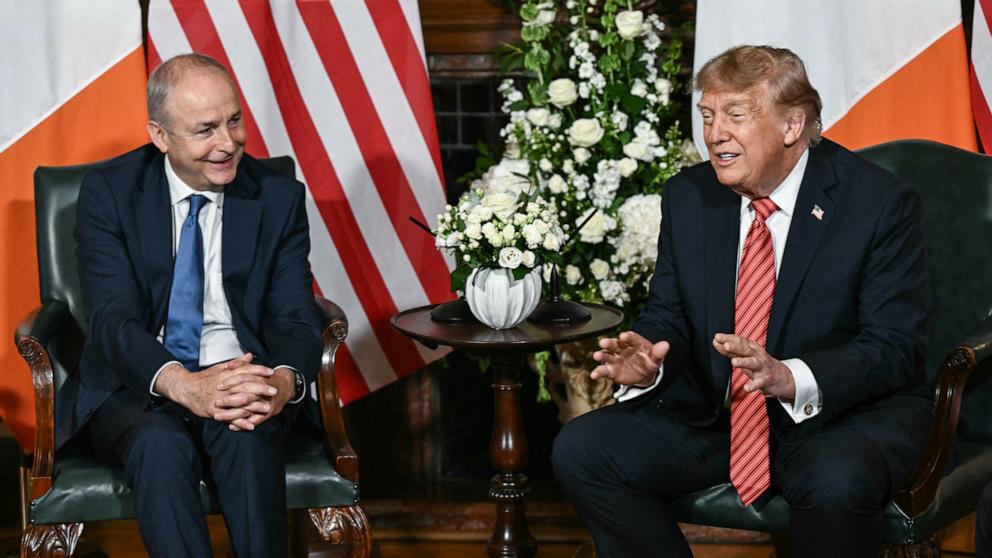
US President Donald Trump has expressed support for the prospect of a united Ireland, saying during his visit to Dublin that he would like to see the island reunified.
Trump made the comments while meeting Taoiseach Micheál Martin, describing Irish unification as something he would consider a positive development.
The remarks immediately attracted attention in both Ireland and the United Kingdom because Northern Ireland remains part of the UK, while its constitutional future is governed by the democratic framework established under the 1998 Good Friday Agreement.
MAIN QUOTE
“I’d love to see it unified”
Trump later joked about the difficulty of answering questions on Irish unity, saying there was “no good answer” regardless of how the issue was addressed, before again describing unification as something that “would be cool”.
The Democratic Unionist Party strongly rejected the suggestion. Its leader, Gavin Robinson, said Northern Ireland’s constitutional future should be determined by its people rather than political comments from London, Dublin or Washington.
Former DUP MP Ian Paisley also criticised Trump’s position, saying:
“Everyone is allowed a personal opinion even when it’s wrong.”
British Conservative leader Kemi Badenoch similarly described Trump’s remarks as unhelpful and stressed that Northern Ireland remains part of the United Kingdom.
Meanwhile, Trump’s comments have generated debate within the Republic of Ireland, where political parties hold differing views about the timing and conditions for any future border poll.
Under the Good Friday Agreement, a referendum on Northern Ireland’s constitutional status can be called when the relevant UK secretary of state considers that it appears likely that a majority would vote for Irish unification.
Trump’s visit has also attracted protests in Dublin, with demonstrators criticising his administration’s foreign policy, particularly its approach to the conflicts in Gaza and the wider Middle East.
Irish President Catherine Connolly said she raised the issue of war and humanitarian concerns during her meeting with Trump, telling him:
“the normalisation of war and genocide can never be accepted”.
COMMENTARY
Trump’s intervention places Irish unity back at the centre of international political discussion, but his support does not alter the constitutional process governing Northern Ireland.
The deeper issue remains one of democratic consent. Any change to Northern Ireland’s constitutional position ultimately depends on the people and the legal mechanisms established under the peace settlement.

