
Race Underway to Decide Ottawa’s Next Mayor as 14 Candidates Enter the Contest
Incumbent Mark Sutcliffe seeks a second term as challengers campaign on affordability, traffic, policing, infrastructure and the future of Ottawa

By: Ebenezer Adugyamfi & Emmanuel Ayiku for GhanaianNewsCanada
October 2, 2026
The race to become Ottawa’s next mayor is officially underway, with incumbent Mark Sutcliffe seeking a second term and 13 challengers competing for the city’s top municipal office.
Ottawa residents will vote on October 26, 2026, as part of Ontario’s municipal elections. Advance voting opportunities are also available, including special advance voting from October 1 to 4 and an additional advance voting day on October 16.
The mayoral contest comes at a time when Ottawa residents are facing a range of issues affecting daily life, including housing affordability, traffic congestion, public safety, transit, homelessness and the condition of city infrastructure.
With nominations now closed, the election has moved from a potential contest into a defined field of candidates campaigning for votes across the national capital.
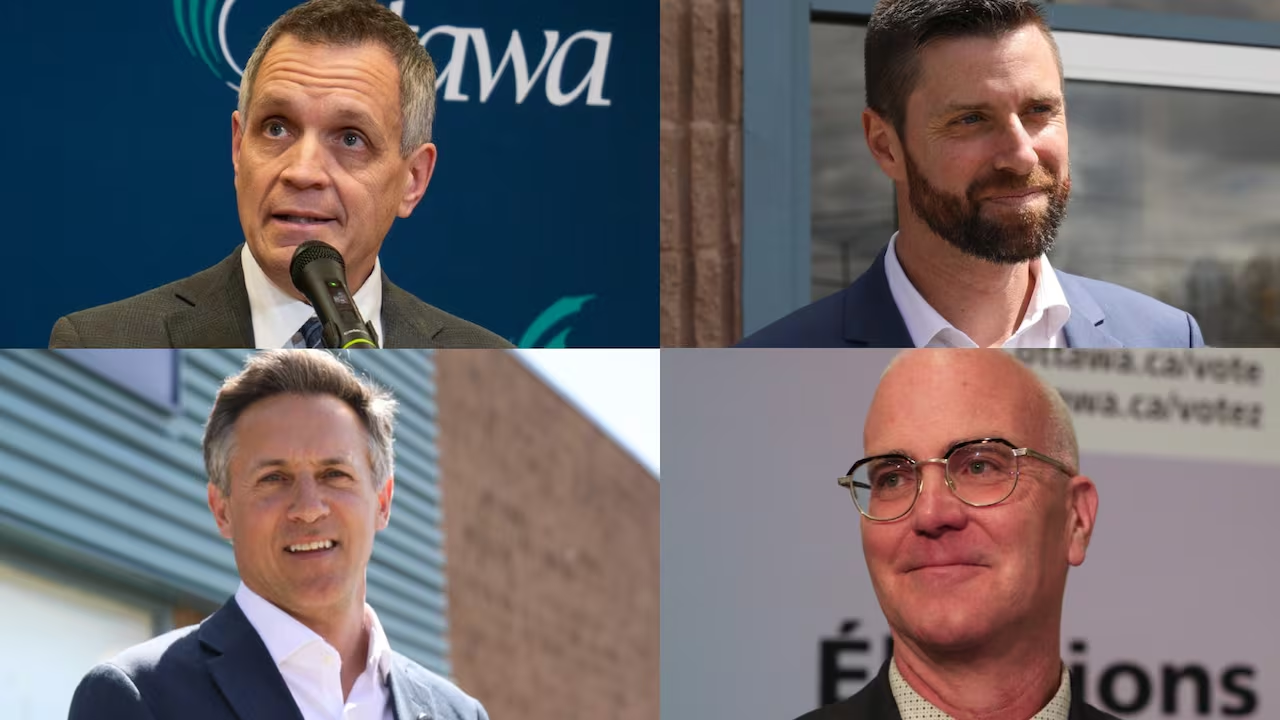
Fourteen candidates are on the mayoral ballot
The City of Ottawa’s certified candidate list includes 14 people running for mayor.
They are:
- Mark Sutcliffe
- Jeff Leiper
- Alex Lawson
- Neil Saravanamuttoo
- Zed Chebib
- Peter Westaway
- Suraj Harish
- Queen Divine Priya Amber Bakshi
- Bernard Couchman
- Ali Shayvard
- Jacob Solomon
- Amjad Ali Syed
- Josh Rachlis
- Geoff Nicholas
Sutcliffe is seeking re-election after winning the mayoralty in 2022.
The field is considerably smaller than the number of people who placed their names on the ballot in the previous municipal election. CityNews reported that there were 14 mayoral candidates after nominations closed in August.
The smaller field, however, does not mean that the election will be without competition. Candidates are campaigning across Ottawa’s 24 wards and are attempting to distinguish themselves on issues that matter to residents in different parts of the city.
Sutcliffe seeks another term
Sutcliffe became mayor in 2022 after defeating several candidates in the municipal election.
During his first term, his administration has dealt with issues ranging from transit and infrastructure to housing, public safety and the city’s finances.
His re-election campaign now gives voters an opportunity to assess his record while the challengers present their own priorities for the next term.
A July survey conducted by Liaison Strategies for Ottawa Compass and iPolitics found Sutcliffe with 36 per cent support among decided voters, compared with 26 per cent for homebuilder Alex Lawson and 25 per cent for Coun. Jeff Leiper. Economist Neil Saravanamuttoo was at 11 per cent in that survey.
The poll surveyed 1,000 Ottawa residents between July 17 and 19 and had a reported margin of error of plus or minus 3.09 percentage points for a comparable probability sample.
However, the survey also found that 34 per cent of respondents were undecided, meaning the figures represented voter intentions at the time of the survey rather than an election result.

Housing and affordability remain major issues
Housing affordability is one of the central issues in the Ottawa campaign.
Like other major Canadian cities, Ottawa has experienced pressure on housing costs and concerns about the availability of affordable homes.
Municipal government has limited control over some factors affecting housing prices, but city council has responsibility for areas including zoning, development approvals, property taxation, infrastructure and some housing-related programs.
Candidates are therefore presenting different approaches to how Ottawa should accommodate population growth while maintaining infrastructure and services.
The July Liaison survey identified housing affordability as the city’s most frequently cited issue, followed by traffic, crime, homelessness, inflation and transit.
Those concerns illustrate the range of challenges facing the next mayor, who will have to work with city council, provincial authorities and the federal government on issues that cross different levels of government.
Traffic and transportation also dominate the campaign
Traffic congestion has become another significant issue for Ottawa voters.
The city’s growing population, construction projects and commuting patterns have contributed to concerns about travel times and transportation infrastructure.
The July poll found traffic had become a more prominent concern, with 17 per cent of respondents identifying it as a top issue, compared with 13 per cent in an earlier survey.
Transit, meanwhile, was identified by 11 per cent of respondents in the July survey.
Ottawa’s public transit system, including OC Transpo, has faced longstanding debates about reliability, service levels and the financial cost of maintaining and expanding the network.
The next mayor and council will therefore inherit decisions involving both transit operations and broader transportation infrastructure.
Public safety is another major campaign issue
Policing and public safety have also become prominent topics in the mayoral campaign.
Ottawa residents have been debating the appropriate level of police presence in neighbourhoods and on public transit, as well as questions concerning police accountability and reform.
The July Liaison survey found that residents were divided over the issue.
According to the survey, 32 per cent said Ottawa needed a more visible police presence in neighbourhoods and on transit, while 29 per cent said the city needed police reform and accountability more than a larger police presence. Another 25 per cent said both were equally necessary.
The findings illustrate that public safety is not a single-issue debate and that voters hold different views about how the city should approach policing.
A diverse set of challengers
Among Sutcliffe’s challengers are people with backgrounds in municipal politics, business and other professional fields.
Jeff Leiper is a sitting Ottawa city councillor representing Kitchissippi Ward and is seeking the mayoralty.
Alex Lawson is a homebuilder and has also emerged as a significant candidate in the campaign.
Neil Saravanamuttoo, an economist, is another candidate who has attracted attention during the campaign.
The remaining candidates are campaigning with varying degrees of visibility and different policy priorities.
With 14 names on the ballot, voters have a wide range of choices, although the size of the field can also make it more difficult for individual candidates to gain citywide recognition.
The campaign is being fought across different parts of Ottawa
Ottawa is geographically and politically diverse.
The concerns of residents in the downtown core can differ significantly from those in suburban communities or rural areas.
The July survey showed significant regional differences in the issues residents considered most important.
For example, housing affordability and crime were particularly prominent concerns in the east, while traffic was more important in the west and south. Central Ottawa respondents placed greater emphasis on transit and homelessness.
Those differences mean mayoral candidates must build support across communities with different priorities.
The mayor is elected citywide, unlike councillors who represent individual wards, making geographic reach an important part of the campaign.
Fewer candidates in the wider municipal election
The mayoral race is taking place alongside contests for city council and school board positions.
The City of Ottawa certified 181 municipal candidates after the nomination period closed in August.
Ten candidates were elected by acclamation, including two city councillors: Riley Brockington in Ward 16 River and David Brown in Ward 21 Rideau-Jock.
The municipal election will determine who represents Ottawa’s wards as well as who occupies the mayor’s office for the next term.
What voters will decide
The mayoral election is ultimately about more than individual personalities.
Ottawa voters will be choosing the person who will lead city council and help set priorities for municipal spending, infrastructure, transportation, housing-related policies, public safety and city services.
The next mayor will also have to work with provincial and federal governments because many of Ottawa’s major challenges involve responsibilities shared across different levels of government.
For Ottawa’s large newcomer and immigrant population, municipal decisions can also affect everyday matters such as housing, transportation, employment access and community services.
October 26 vote approaches
The official voting day for Ottawa’s 2026 municipal election is Monday, October 26.
Eligible voters can also use the city’s advance voting opportunities, including the special advance period from October 1 to 4 and the regular advance voting day on October 16.
The campaign will continue to develop as candidates make their final appeals to voters and debate how Ottawa should address affordability, traffic, public safety, transit, homelessness and infrastructure.
With 14 candidates officially on the mayoral ballot, Ottawa residents will ultimately decide who will lead the city for the next municipal term.
The result will be determined on election day, when voters across the capital cast their ballots for mayor, councillor and school board trustee.

