
Ghana’s Economy Grows 6.2% in First Half of 2026 as ICT, Oil and Investment Drive Expansion
Growth remains strong despite a slight slowdown in the second quarter, with digital services, oil production and investment providing much of the momentum

By: Ebenezer Adugyamfi/ Emmanuel Ayiku for GhanaianNewsCanada | September 10, 2026
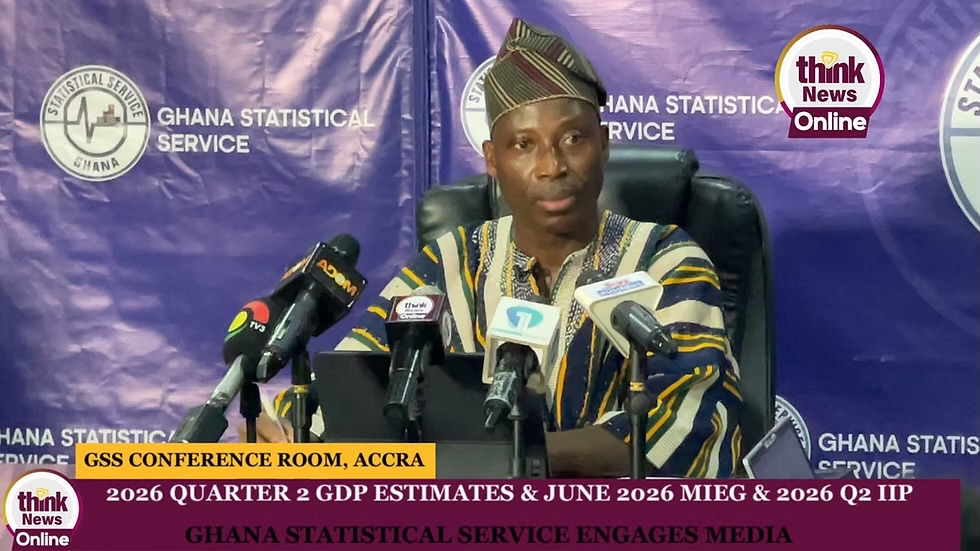
Ghana’s economy expanded by 6.2% in the first half of 2026, maintaining a strong pace of growth despite a slight slowdown in the second quarter, according to the latest figures from the Ghana Statistical Service (GSS).
The economy grew by 6.0% between April and June, compared with 6.1% recorded during the same period in 2025.
The latest figures point to continued economic expansion, with the strongest contributions coming from the services sector, particularly information and communications technology (ICT), alongside oil and gas production and investment.
The performance provides another indication that economic activity has remained resilient as Ghana continues efforts to stabilise its finances and strengthen growth.
Services remain at the centre of the expansion
The services sector continued to be Ghana’s largest engine of economic growth.
It expanded by 8.0% in the second quarter, accounting for 57.6% of overall GDP growth during the period.
Within services, ICT stood out as the strongest-performing activity.
The sector grew by 30.9%, contributing 41.5% of total economic growth during the quarter.
The performance reflects the growing importance of digital services to Ghana’s economy, as telecommunications, technology-related businesses and other information services become increasingly important to economic activity.
The figures also underline how much of Ghana’s recent growth is being generated by modern service-based activities rather than traditional sectors alone.
Oil and gas provide a boost to industry
Oil and gas production also played an important role in the latest performance.
The industrial sector grew by 4.3% in the second quarter, with stronger oil and gas activity helping to support the expansion.
The increase in petroleum production comes at an important time for Ghana, where the oil sector remains a significant source of export earnings and government revenue.
However, the latest figures also show that the country’s economic performance is not dependent solely on oil.
The non-oil economy grew by 5.4% in the second quarter, bringing non-oil growth for the first half of 2026 to 5.9%.
That suggests economic activity outside the petroleum sector continues to expand, although at different rates across individual industries.
Investment jumps sharply
Investment was another major source of growth during the quarter.
Investment increased by 53.0%, while domestic demand grew by 11.2%.
The increase in investment could have wider implications for the economy if it translates into new businesses, infrastructure, production capacity and employment.
For Ghana, the challenge will be ensuring that stronger investment is sustained and that the resulting economic activity reaches households and businesses across the country.
Economic growth is measured by the increase in the value of goods and services produced, but stronger GDP figures do not automatically mean that every household experiences an improvement in living standards.
Agriculture grows more slowly
Agriculture continued to expand, but at a considerably slower pace than services.
The sector recorded growth of 3.9% during the second quarter.
The performance highlights one of the challenges facing Ghana’s economy: growth remains uneven across major sectors.
While ICT and other services are expanding rapidly, agriculture continues to face structural challenges that can affect productivity, incomes and employment.
Fishing was particularly weak during the period, recording a significant contraction.
The uneven performance means that sustaining economic growth over the longer term could depend on increasing productivity in agriculture as well as expanding opportunities in manufacturing and other productive sectors.
What does the 6.2% growth mean for Ghanaians?
The headline growth figure is encouraging, but its impact will ultimately be judged by what it means for ordinary households.
A stronger economy can create opportunities for businesses to expand, increase employment and generate additional government revenue.
But GDP growth alone does not guarantee lower living costs or higher incomes.
For many Ghanaians, the more important questions will be whether economic expansion leads to better-paying jobs, more affordable goods and services, improved public infrastructure and greater opportunities for young people.
The government will therefore face pressure to convert the improving economic indicators into tangible improvements in living standards.
A stronger first half, but challenges remain
Ghana entered 2026 with renewed efforts to restore macroeconomic stability, strengthen public finances and encourage investment.
The latest GDP figures suggest that economic activity has remained relatively strong.
However, the slight slowdown from the previous year’s second-quarter performance shows that maintaining the current pace of expansion will require continued investment and productivity improvements.
There are also significant differences between sectors.
Services and ICT are expanding rapidly, while agriculture is growing more slowly. This raises questions about how evenly the benefits of economic growth are being distributed.
The first-half figure of 6.2% nevertheless represents a solid expansion and keeps Ghana’s economy on a positive trajectory.
The focus now will be on whether that momentum can be maintained through the second half of the year — and whether stronger economic activity can translate into jobs, higher incomes and improved living conditions for people across Ghana.
For policymakers, the next challenge is no longer simply achieving growth, but ensuring that the growth is broad-based, sustainable and felt beyond the sectors currently driving the economy.

