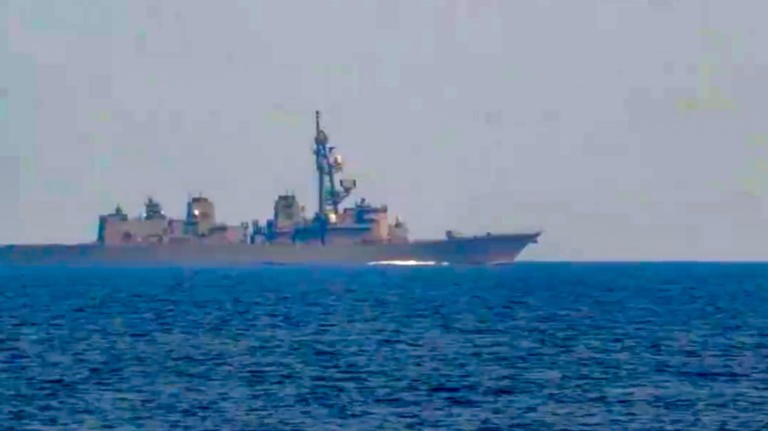
The JS Ikazuchi’s passage through the waterway on Friday ‘harmed the feelings of the Chinese people’
Tensions in East Asia reached a fresh peak with a Japanese warship’s transit of the Taiwan Strait on a historically freighted date for China.
According to the PLA Eastern Theatre Command, the Japanese destroyer JS Ikazuchi spent 14 hours navigating the sensitive waterway on Friday, the anniversary of the 1895 Treaty of Shimonoseki or Treaty of Maguan, an unequal treaty that forced the then-ruling Qing dynasty administration to cede Taiwan to Japanese colonial rule.
In a commentary on Saturday, the military mouthpiece PLA Daily accused Tokyo of “harming the feelings of the Chinese people” by timing the transit to coincide with the anniversary.
Do you have questions about the biggest topics and trends from around the world? Get the answers with SCMP Knowledge, our new platform of curated content with explainers, FAQs, analyses and infographics brought to you by our award-winning team.
“This is not just a ‘grey zone’ tactic; it is an act that heightens global vigilance against Japan’s ‘new militarism’,” the commentary said.
The People’s Liberation Army sent naval and air forces to monitor the vessel, with the defence ministry saying the PLA forces maintained “effective regulation and control”.
The armed forces also released drone footage of the encounter to signal tactical dominance.
The Chinese foreign ministry said the transit amounted to Japan “doubling down on mistakes”.
Beijing sees Taiwan as part of China to be reunited by force if necessary. Most countries, including the United States and Japan, do not recognise Taiwan as an independent state, but Washington is opposed to any attempt to take the self-ruled island by force and is committed to supplying it with weapons.
In an apparent response to the transit, the Eastern Theatre Command sent a naval formation through the Yokoate Channel into the Western Pacific for “routine” combat training on Sunday.
The Yokoate Channel is a strategic gateway to the open Pacific heavily guarded by Japanese forces.
The PLA said its movements through the channel were “not directed at any specific country” and complied with international law.
Elsewhere, the Japanese coastguard reported a Chinese marine research vessel conducting unauthorised activity near the disputed Diaoyu Islands, a group of eight uninhabited islands in the East China Sea known as the Senkakus in Japan.
The transit compounds strains stemming from remarks by Japanese Prime Minister Sanae Takaichi in November, when she suggested that a Taiwan contingency could be a “survival-threatening situation” for Japan, justifying the mobilisation of its armed forces.
Beijing has repeatedly requested that Takaichi withdraw those remarks, something that she has refused to do.
Despite the fierce rhetoric, Chinese analysts said Beijing’s response had been one of “calculated restraint”.
“The PLA’s response remains within conventional bounds,” said Ni Lexiong, a professor at the Shanghai University of Political Science and Law.
“Expressions such as ‘effective regulation and control’ provide more room for tactical operations, but are still routine.
“Beijing is avoiding an escalation because its current strategic focus remains anchored on diplomatic priorities in the Middle East. It will not allow itself to overreact to Japan’s manoeuvres.”
Zhang Peng, associate professor at Shanghai International Studies University’s school of business and management, agreed that relations had not yet reached a breaking point.
“Chinese diplomacy has a pragmatic and restrained side,” Zhang said.
“In the eyes of Beijing, Japan is ultimately a middle power. If Tokyo continues to make greater mistakes, it only provides China with more diplomatic leverage.”
However, the Japan Self-Defence Forces are expanding their activities in the region.
Japan’s Joint Staff announced on Tuesday that the SDF would deploy about 1,400 personnel, multiple warships and aircraft, as well as Type 88 anti-ship missile systems for the Balikatan exercise, an annual large-scale joint military drill between the Philippines and the United States.
It is the first time that Japan is taking an active part in the drill, which runs from April 20 to May 8.