
Major U.S.–Israel Strikes on Iran Spark Widening Conflict Across Middle East
Death of Iran’s Supreme Leader ignites regional retaliation as global tensions rise
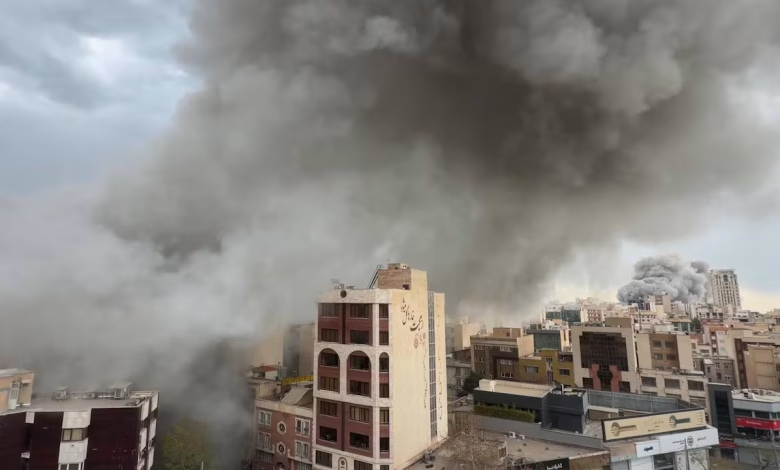
Vast airstrikes launched by the United States and Israel against Iran over the weekend have plunged the Middle East into a broader conflict, with Iran’s Supreme Leader Ayatollah Ali Khamenei reportedly killed, and Tehran and its regional allies launching retaliatory attacks on multiple fronts. The situation is unfolding rapidly, with impacts felt not only across the region but also in global diplomacy, travel and market stability.
Coordinated Strikes and the Death of Khamenei
The U.S. and Israeli offensive began with a coordinated series of strikes inside Iran aimed at military and strategic leadership targets. Officials in Washington and Tel Aviv said their objective was to degrade Iran’s nuclear and missile capabilities and put pressure on the regime’s command structure following weeks of stalled diplomacy. In the initial bombardment, Iran’s long-time Supreme Leader Ayatollah Ali Khamenei was reported killed — a development that Iranian authorities acknowledged days after the attacks began.
Khamenei, who had led Iran since 1989, was the country’s highest authority, with ultimate control over its government and military structures. His death represents an extraordinary turning point in Iranian history and has significant implications for the country’s internal political trajectory.
Retaliation and Regional Escalation
Iran responded with a barrage of missile and drone strikes against Israeli territory and U.S. military bases scattered across Gulf nations. The conflict quickly spread beyond Iran’s borders, drawing in Iranian-aligned groups and neighbouring countries:
-
Hezbollah, an Iranian-allied militia in Lebanon, fired missiles into northern Israel, prompting Israeli retaliatory strikes in Lebanon, which have killed dozens and injured many more.
-
Missile and drone attacks hit Gulf Arab states, including the UAE and Kuwait, forcing airspace closures that disrupted regional air travel.
-
One dramatic incident saw Kuwaiti air defenses mistakenly down three U.S. fighter jets amid active combat, though all pilots survived.
This escalation has raised fears that the conflict could spread further, drawing regional actors more deeply into all-out war.
Impact on Civilians and International Reaction
The toll on civilians has been profound. Iranian health officials report hundreds of civilian deaths and injuries, including strikes on residential areas — and, according to some independent accounts, even a tragic hit on a primary school in southern Iran, resulting in dozens of deaths.
Internationally, world leaders have reacted with deep concern:
-
The United Nations Security Council convened emergency sessions, with the U.N. Secretary-General condemning the strikes and Iran’s retaliation, and urging immediate ceasefire and diplomacy.
-
Major powers like China have denounced the assault as unacceptable and urged a return to negotiations.
-
European nations have expressed support for diplomatic solutions while warning against further escalation that could draw in additional state and non-state actors.
Effects on Travel, Markets and Global Stability
The conflict has also had far-reaching practical consequences:
-
Global air travel has been severely disrupted, with numerous flights cancelled or rerouted due to widespread airspace closures across the Middle East.
-
Oil and energy markets have reacted sharply, with prices spiking amid uncertainty around shipping through the Strait of Hormuz, a critical global energy chokepoint affected by reduced vessel traffic.
-
Canada, for its part, has seen flight cancellations affecting routes to the region, and authorities have issued travel warnings covering much of the Middle East.
Canada’s Response and Domestic Implications
Canadian Prime Minister Mark Carney has publicly supported the U.S. in its security objectives while making clear Canada will not participate militarily in the conflict. Canadian officials have reiterated that there is no “imminent threat” to Canada or Canadians, but have urged vigilance against extremist actions that can be inspired by global tensions.
In addition to travel and safety advisories, experts say Canada’s pro-U.S. stance carries broader security and political risks, including potential retaliation by hostile proxies or cyber operations, even if Canada remains outside direct combat.
What Comes Next?
At this stage, there is no clear end in sight to the conflict. Officials in Washington and Tel Aviv have vowed the military campaign will continue until its objectives — including disrupting Iran’s strategic capabilities — are met, but global leaders and institutions are pressing for ceasefire and diplomatic engagement.
As the situation continues to evolve, analysts warn that the war’s next phase could further reshape Middle Eastern geopolitics, test international alliances, and have ongoing consequences for security, trade and civilian life worldwide.
Key Facts at a Glance
-
Coordinated U.S.–Israel airstrikes targeted Iran’s military and leadership sites, reportedly killing Supreme Leader Ayatollah Ali Khamenei.
-
Iran launched retaliatory missile and drone attacks on Israel, U.S. bases, and Gulf states.
-
Hezbollah struck Israel from Lebanon, drawing Israeli counter-attacks.
-
Air travel, energy markets, and regional stability have all been severely disrupted.
-
Canada supports U.S. objectives but will not send troops; officials warn of vigilance at home against secondary impacts.


