
Tesla Unveils Flying Roadster With SpaceX Thrusters, but Production Remains Years Away
The futuristic electric sports car performed mid-air manoeuvres during a Texas demonstration, but questions remain about its commercial launch, safety and practical use on public roads.

By: Ebenezer Adugyamfi | Emmanuel Ayiku, Reporting for GhanaianNewsCanada
October 16, 2026
Tesla has unveiled a redesigned version of its long-delayed Roadster electric sports car, showcasing a prototype equipped with rocket-style thrusters developed in collaboration with SpaceX in a dramatic demonstration that pushed the boundaries of conventional automotive engineering.
The vehicle was demonstrated on Thursday, October 15, at a SpaceX testing facility in McGregor, Texas, where it performed a series of extraordinary manoeuvres, including driving upside down on a specially designed ramp, turning in mid-air and landing back on the ground.
The presentation, led by Tesla chief executive Elon Musk, renewed attention around a vehicle that has remained in development for years and faced repeated delays.
Despite the spectacular demonstration, Tesla does not expect to begin production until 2028. The company has yet to establish that the prototype’s unusual aerial capabilities will be available in a commercially produced vehicle that can be legally and safely operated on public roads.
A sports car designed to push conventional limits
The new Roadster represents an ambitious attempt to combine high-performance electric-car engineering with technology associated with the aerospace industry.
Developed with SpaceX, Musk’s rocket company, the vehicle uses rocket-style thrusters intended to help it manoeuvre in the air. A suction system also allows the demonstrated prototype to maintain contact with a specially designed ramp while travelling upside down.
During the event, the vehicle climbed the curved ramp, continued along it while inverted, then left the structure and performed an aerial turn before landing.
A subsequent demonstration showed the car using its thrusters to jump over other vehicles.
The demonstrations were designed to highlight the potential of the technology, although they do not establish how the system would perform under everyday driving conditions or whether all the showcased capabilities will feature in the final production model.
Tesla has long positioned the Roadster as a vehicle that could challenge expectations about electric-car performance. The latest presentation takes that ambition considerably further by introducing technology more commonly associated with spacecraft and experimental flight systems.
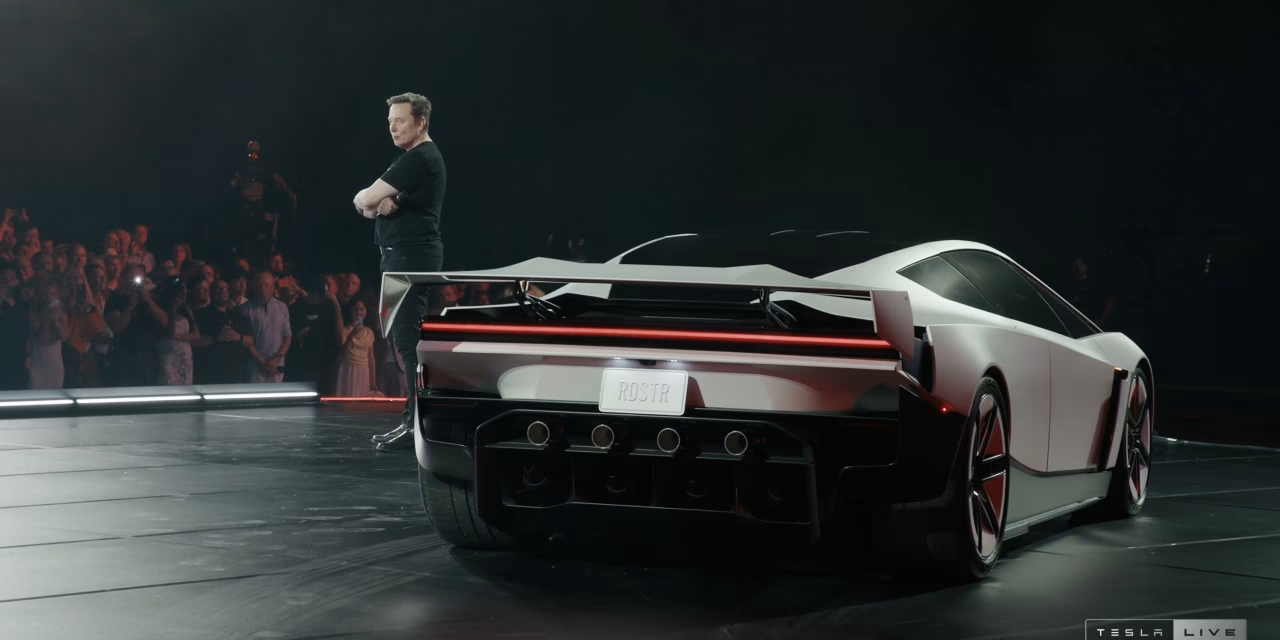
Tesla claims acceleration of less than one second
Tesla vehicle engineering chief Lars Moravy said the Roadster could accelerate from zero to 60 miles per hour in less than one second, equivalent to approximately 97 kilometres per hour.
The company also cited a top speed exceeding 230 miles per hour, or about 370 kilometres per hour, and a driving range of more than 300 miles on a single charge.
These are extraordinary performance claims, but the specifications will need to be assessed against the final production vehicle rather than the demonstration prototype alone.
Tesla has not yet provided a definitive delivery schedule that would put the production model in customers’ hands before its stated 2028 production target.
The company also faces questions about how the thrusters, associated equipment and other specialised systems will affect the vehicle’s weight, price, maintenance requirements and regulatory approval.
A long-delayed project
The latest unveiling comes nearly a decade after Tesla first presented a prototype of the second-generation Roadster in 2017.
At the time, Tesla promised a high-performance electric sports car with ambitious acceleration and driving-range figures, with customer deliveries initially expected much earlier than the current production target.
The company subsequently postponed the launch several times, leaving some early reservation holders waiting for years.
The original Roadster, introduced in 2008 and sold until 2012, was Tesla’s first production vehicle. Based on the Lotus Elise chassis, it helped demonstrate that an electric vehicle could offer sports-car performance rather than serving solely as a practical alternative to petrol-powered cars.
That early model played a role in establishing Tesla’s reputation as an electric-vehicle innovator.
The new version is expected to serve a different but related purpose: showcasing the company’s engineering capabilities at a time when its business priorities are increasingly focused on autonomous driving, artificial intelligence and robotics.
How much will the new Roadster cost?
Tesla has not announced a definitive final purchase price for the redesigned Roadster at the unveiling.
The company’s reservation information following the presentation listed a Performance version requiring a US$50,000 deposit and a Thrust version featuring acceleration thrusters requiring a US$250,000 deposit.
Tesla also described an invitation-only Rocket variant as a single-seat model featuring a full flight system.
These deposits should not be confused with the vehicle’s complete purchase price. Buyers will need further information about final pricing, specifications, delivery terms and which features will be available in each version.
The different configurations also leave important questions about the distinction between the vehicle’s road-going performance features and its more experimental flight-related capabilities.
The absence of a final price means potential buyers cannot yet make a complete assessment of the cost of ownership.
Safety and road legality remain important questions
Musk acknowledged during the presentation that the vehicle was not necessarily optimised for safety and that its legality could vary between jurisdictions.
That warning is significant because a vehicle capable of leaving the ground presents regulatory and engineering challenges beyond those associated with conventional electric cars.
Automotive safety requirements, road-use regulations and aviation rules may all become relevant, depending on how the final system operates and whether the vehicle is intended to fly beyond controlled demonstrations.
A successful demonstration does not automatically establish that the vehicle is ready for unrestricted use on public roads, much less that its flight-related capabilities have received all necessary approvals.
Tesla will need to provide clearer information about the system’s operating limits, emergency safeguards, reliability and intended uses before consumers can determine whether the technology has practical value beyond a demonstration.
The company’s production target of 2028 leaves time for further development, but it also means that the vehicle’s eventual capabilities and regulatory status remain uncertain.
A prestige project as Tesla shifts towards AI and robotics
The Roadster unveiling comes as Tesla reconsiders the direction of its business and places greater emphasis on artificial intelligence, autonomous vehicles and robotics.
The company has been developing its Cybercab robotaxi concept and its Optimus humanoid robot programme, reflecting Musk’s broader vision of a future in which autonomous systems play a larger role in transportation and everyday work.
Tesla’s mainstream vehicle business, meanwhile, continues to depend heavily on models such as the Model 3 and Model Y.
Musk has previously played down the Roadster’s likely financial contribution, describing it as a project unlikely to make a major difference to Tesla’s overall finances.
However, the vehicle could serve as a prestige model, showcasing technologies that Tesla hopes will reinforce its image as an innovative engineering company.
Morningstar analyst Seth Goldstein has described the Roadster as a potential “halo car” — a high-performance model intended to demonstrate a manufacturer’s technological capabilities and enhance its broader brand image.
The strategy also comes as investors scrutinise Tesla’s financial performance and the commercial prospects of its newer technology programmes.
The Roadster may generate considerable attention, but its eventual success will depend on more than the spectacle of its launch. Production costs, delivery schedules, reliability, customer demand and the final vehicle’s capabilities will all matter.
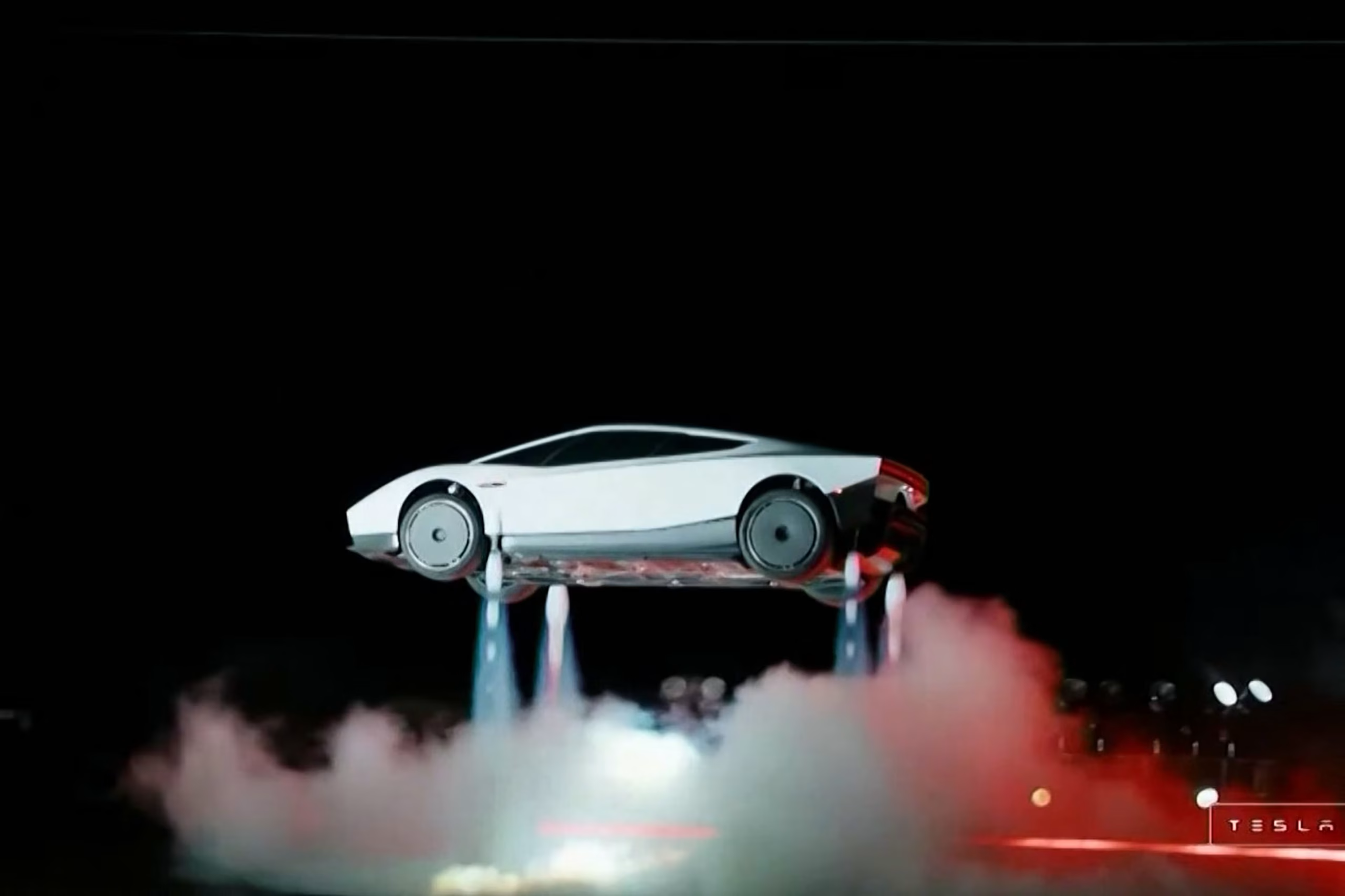
Can flying cars become practical?
The Roadster demonstration has revived a longstanding vision of vehicles that can move beyond the limits of conventional road transportation.
However, there is an important distinction between a car briefly performing an aerial manoeuvre under controlled conditions and a practical flying vehicle suitable for widespread public use.
A commercially viable flying car would have to address issues including passenger safety, stability, energy requirements, noise, maintenance, emergency procedures and regulation.
It would also need to operate reliably outside a carefully controlled demonstration environment.
For Tesla, the challenge will be to translate its prototype’s striking performance into a production vehicle that meets customer expectations and applicable safety standards.
The company’s 2028 target gives it more time to develop the technology, but the repeated delays associated with the Roadster mean that prospective buyers will be watching for concrete evidence of progress.
For now, the unveiling offers a glimpse of an ambitious possible future for electric vehicles rather than proof that flying cars are ready to become part of everyday transportation.
The next major test will be whether Tesla can deliver the promised vehicle on schedule, at a clearly defined price and with capabilities that can be used safely and legally beyond a controlled demonstration.

