By Ebenezer Adu-Gyamfi / Emmanuel Ayiku | Reporting for Ghanaian News Canada | April 19, 2026

The Minority Leader in Parliament, Alexander Afenyo-Markin, has issued a strong caution to members of Ghana’s judiciary, urging them to remain independent and resist any form of political or external influence in the discharge of their duties.
His remarks come amid growing national conversations about judicial independence and the role of the courts in Ghana’s democratic system.
Addressing judges, Afenyo-Markin emphasized the importance of upholding the integrity of the legal system by strictly adhering to the Constitution and their judicial oath.
“Please apply your legal brain, common sense and abide by your judicial oath,” he stated, stressing that judicial decisions must be guided by law rather than external pressure.
He further warned judges against acting on what he described as “unseen instructions” or informal directives, cautioning that such actions could have lasting consequences.
“Know that if you follow unseen instructions… you will be on your own. Your decisions shall become part of the public record and posterity will judge you,” he added.
The Effutu Member of Parliament also referenced Article 296 of Ghana’s 1992 Constitution, which governs the exercise of discretionary power, urging judges to remain faithful to constitutional principles in their rulings.
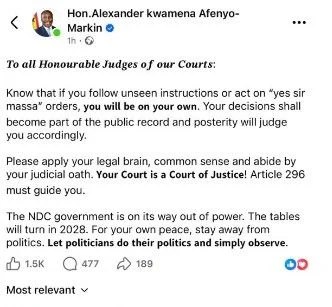
Afenyo-Markin further advised members of the bench to avoid political entanglements, insisting that the judiciary must remain insulated from partisan activities.
“Stay away from politics… let politicians do their politics,” he stated, reinforcing the need for a clear separation between the judiciary and political actors.
His comments have added to ongoing debates about the independence of Ghana’s judiciary, particularly at a time when legal and political issues continue to intersect in national discourse.
Observers say such statements reflect broader concerns about maintaining public confidence in the justice system, with calls for transparency, neutrality, and strict adherence to the rule of law.
As discussions continue, the spotlight remains on how Ghana’s judicial system navigates the balance between constitutional authority and external pressures.