By Boakye Stephen, Kumasi, Ghana | Reporting for Ghanaian News, Canada
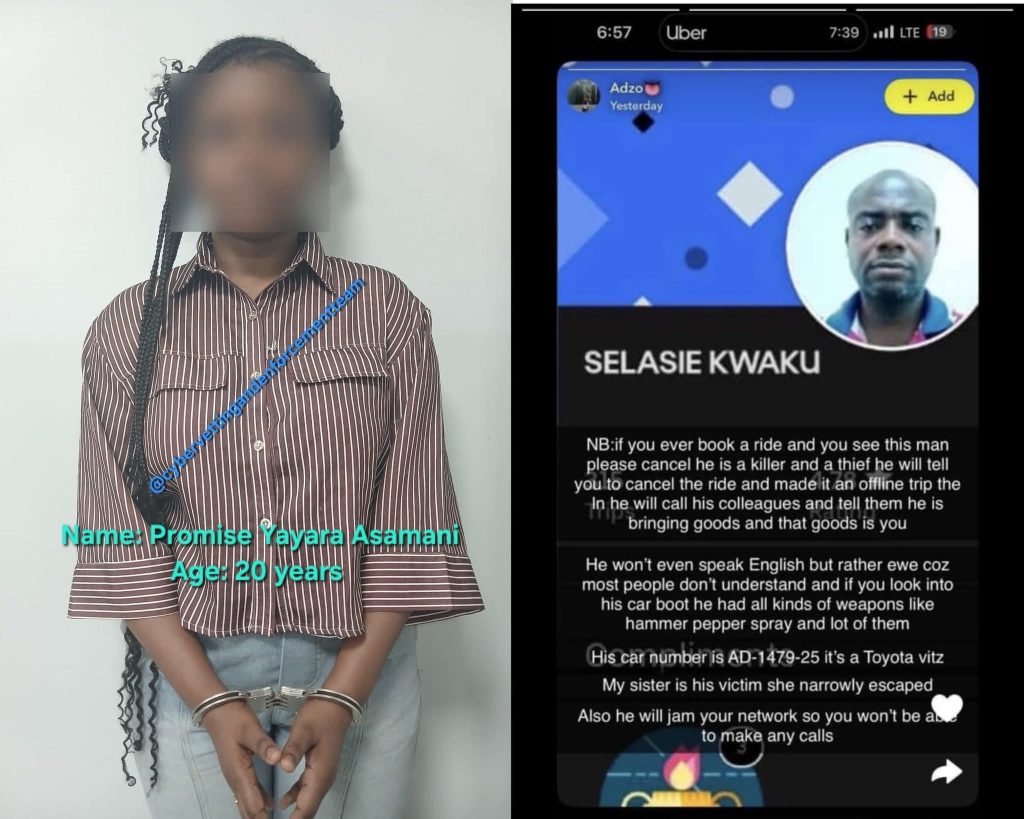
A 20-year-old woman, Promise Yayra Asamani, has been arrested by the Ghana Police Service’s Cyber Vetting and Enforcement Team for allegedly spreading false information on social media that wrongly portrayed an Uber driver as a criminal.
The arrest follows a complaint filed by Selasie Kwaku Anthonio, a 43-year-old driver, whose photograph and vehicle details were widely circulated online with serious allegations describing him as a “murderer and a thief.”
According to police findings, the viral Snapchat post included the driver’s image and car registration number AD-1479-25, alongside claims that he used signal jammers to cut off passengers’ networks and carried weapons to commit crimes.
The consequences were immediate and severe. The driver’s Uber account was suspended, effectively cutting off his main source of income. He also reported receiving distressing calls from family members and customers, while expressing fear for his safety due to the risk of mob action.
Investigations traced the origin of the claims to a misunderstanding involving the suspect’s sister, who had taken a ride with the driver from Spintex to Oyibi on March 9, 2026. She later reported concerns about the driver’s conduct, including a request to go “off-trip” and items she claimed to have seen in the vehicle.
After sharing her suspicions with her siblings, Promise Yayra Asamani proceeded to publish the claims online. During police interrogation, she admitted that the post, describing the driver as a “killer”, was based solely on her sister’s account and was not supported by any verified evidence.
She reportedly stated that her intention was “to create awareness.”
The suspect was arrested on March 14 after initially failing to respond to a police invitation and has since been granted enquiry bail while investigations continue.
Commentary | Boakye Stephen
This incident highlights the dangerous power of social media in shaping public perception within seconds, often without verification. A single unverified post was enough to destroy a man’s reputation, disrupt his livelihood, and expose him to potential physical harm.
It also underscores the growing challenge of digital irresponsibility, where individuals act as informal “publishers” without understanding the legal and ethical consequences of their actions. The line between awareness and defamation is often ignored, with serious real-world implications.
The risk of mob justice in Ghana makes such cases even more critical. Labeling someone a criminal online, especially without evidence, can lead to irreversible consequences, including violence.
From a broader perspective, this case reinforces the urgent need for digital literacy, responsible communication, and stronger enforcement of cyber laws. Freedom of expression must be balanced with accountability, particularly in an era where information spreads faster than truth.
The Ghana Police Service has reiterated that the publication of false news is a punishable offence and has urged the public to verify information before sharing.