


By Ebenezer Adu-Gyamfi / Emmanuel Ayiku
For GhanaianNewsCanada | March 6, 2026
As Ghana celebrates another milestone in its independence journey, renewed discussions have emerged about the historical figures whose ideas helped shape the nation’s identity. A Ghanaian writer has sparked debate by asserting that two of the country’s most symbolic national elements—Independence Day on March 6 and the Ghanaian national flag—are legacies connected to the intellectual and political influence of Joseph Boakye Danquah, popularly known as J.B. Danquah.
The claim highlights the continuing debate among historians and political thinkers over the contributions of key nationalist leaders during the struggle for independence from British colonial rule.
The Historical Context of Ghana’s Independence
Ghana, formerly known as the Gold Coast, became the first sub-Saharan African country to gain independence from colonial rule on March 6, 1957. The independence movement was led by several nationalist figures, most prominently Kwame Nkrumah, who eventually became the country’s first Prime Minister and later its President.
However, Ghana’s independence struggle was not the effort of one individual alone. It involved a group of intellectuals, politicians, and activists who mobilized the population against colonial rule.
Among them was J.B. Danquah, a founding member of the United Gold Coast Convention (UGCC), a political movement that played a critical role in organizing early nationalist efforts against British administration.
Claim: Danquah’s Role in Selecting March 6
According to the writer behind the recent claim, the date March 6 was not randomly chosen for Ghana’s independence celebrations. The argument suggests that J.B. Danquah had earlier proposed the date as symbolically important in Ghana’s historical narrative.
The claim argues that Danquah believed the date carried deep political and historical meaning tied to the nation’s identity and the colonial transition period.
Supporters of this perspective maintain that Danquah’s intellectual contributions were instrumental in shaping discussions among nationalist leaders about the direction and symbolism of the emerging state.
While historians acknowledge that the final declaration of independence came under the leadership of Kwame Nkrumah, debates about who proposed certain ideas or strategic decisions remain part of Ghana’s broader historical discourse.
The Symbolism of Ghana’s National Flag
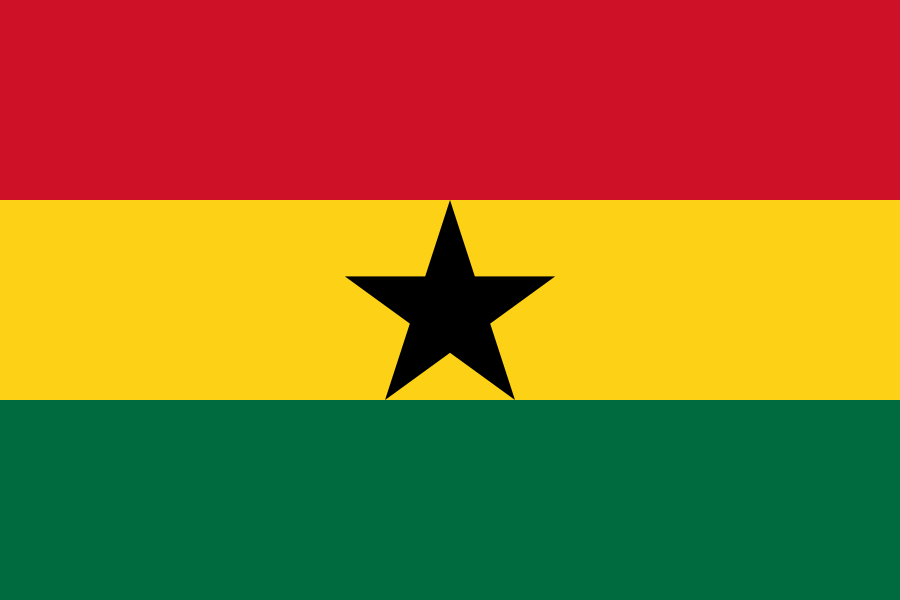
Another major element mentioned in the writer’s claim concerns the Flag of Ghana, which consists of three horizontal stripes of red, gold, and green, with a black star at the center.
The flag was designed by renowned Ghanaian artist Theodosia Okoh and officially adopted in 1957 following independence.
According to the argument presented, the symbolic foundations behind the flag—including its Pan-African colors and philosophical meaning—were influenced by the broader nationalist ideas championed by figures such as J.B. Danquah and other members of the independence movement.
Supporters of this view say the intellectual climate created by nationalist thinkers helped shape the symbols chosen to represent the new nation.
The Continuing Debate Over Historical Credit
The issue of who deserves credit for Ghana’s independence and national identity has been a recurring topic in the country’s political and academic discussions.
Some scholars and political commentators describe J.B. Danquah as one of the founding intellectual architects of modern Ghana, noting his contributions to nationalist ideology, legal thought, and political organization.
Others argue that the practical leadership and mobilization led by Kwame Nkrumah ultimately drove the independence movement to success.
These differing perspectives highlight the complexity of Ghana’s history, where multiple figures played significant roles in shaping the nation’s future.
Remembering J.B. Danquah’s Legacy
J.B. Danquah was born in 1895 in Bepong in the Eastern Region and later became one of the most influential intellectuals in Ghana’s political history. A lawyer, philosopher, and politician, he was known for advocating democratic governance, constitutional rule, and political freedom.
His contributions ranged from political organizing to cultural research, including scholarly work on the origins and identity of the Ghanaian people.
Danquah passed away in 1965 while in detention during the political tensions of the early post-independence era, but his legacy continues to be discussed decades later.
Independence Day: A Moment of Reflection
As Ghana marks Independence Day each year on March 6, the occasion serves as more than just a celebration of freedom from colonial rule. It also provides an opportunity to reflect on the diverse personalities and ideas that contributed to the birth of the nation.
The latest claim by the Ghanaian writer has once again drawn attention to the historical role of J.B. Danquah and the broader conversation about the architects of Ghana’s independence.
Whether through political leadership, intellectual contributions, or cultural influence, the story of Ghana’s independence remains a collective narrative shaped by many pioneers.
