Writers: Ebenezer Adu-Gyamfi / Emmanuel Ayiku
GhanaianNewsCanada | March 19, 2026

According to internal planning documents, Global Affairs Canada believes it must “take more risks” and challenge traditional assumptions in how it operates internationally.
This shift reflects growing concerns within government circles that existing diplomatic strategies may no longer be sufficient to deal with rapidly evolving global challenges.
A World Marked by Rising Uncertainty
The new direction comes at a time when global instability is intensifying. From geopolitical tensions to economic disruptions and climate-related threats, policymakers are facing a more complex international environment than in previous decades.
Recent global developments—including conflicts in the Middle East—have already contributed to rising oil prices, market instability, and fears of inflation, all of which are putting pressure on economies worldwide.
At the same time, experts warn that broader risks such as economic confrontation, global conflict, and misinformation are increasing, with many predicting a turbulent global outlook in the coming years.
Adapting to Budget Constraints and Policy Changes
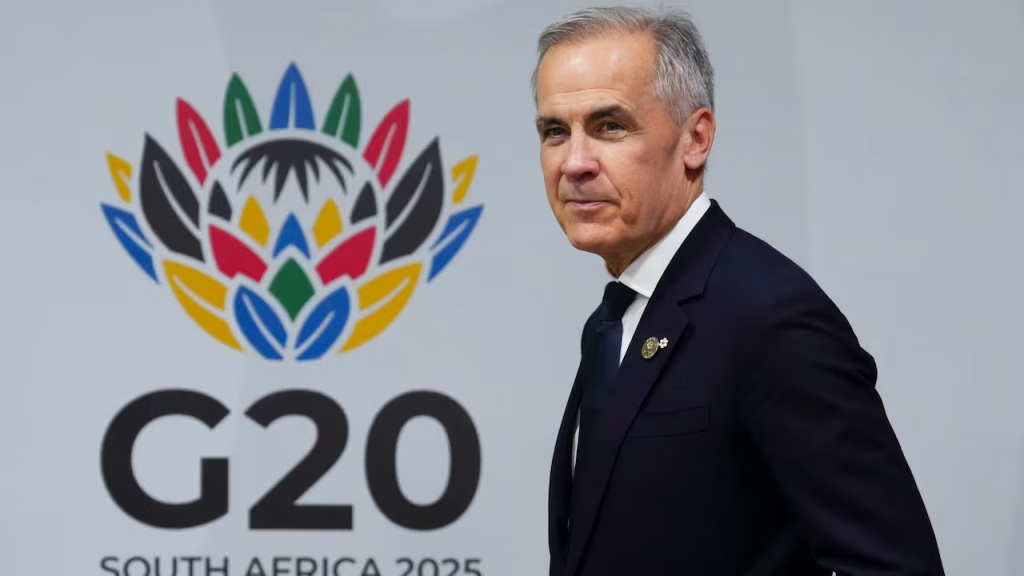
The shift in strategy is also linked to domestic realities. The department is reportedly adjusting its priorities in response to public service spending cuts under Prime Minister Mark Carney’s administration.
This means Global Affairs Canada may need to focus its resources more strategically, choosing where to engage more deeply and where to scale back.
Rather than spreading efforts thinly across many areas, the department is expected to prioritize high-impact initiatives that align with Canada’s core interests and global influence.
Expanding Focus on Global Risks
Canada’s foreign policy is increasingly being shaped by major global risks, including:
-
Climate change and environmental instability
-
Food insecurity and global supply chain disruptions
-
International conflicts and geopolitical competition
-
Cybersecurity and misinformation threats
According to official planning frameworks, Canada aims to strengthen partnerships and invest in initiatives that promote global stability while addressing these interconnected challenges.
Climate change, in particular, remains a critical concern, with rising temperatures, wildfires, and extreme weather events already affecting Canada and other parts of the world.
A Shift Toward Strategic and Calculated Risk
The idea of “taking more risks” does not necessarily mean reckless decision-making. Instead, it reflects a willingness to move beyond traditional diplomatic caution and adopt more proactive and innovative approaches.
This could include:
-
Engaging in complex or sensitive international negotiations
-
Taking stronger positions on global issues
-
Building new alliances beyond traditional partners
-
Responding more quickly to emerging crises
Officials believe that in a rapidly changing world, sticking strictly to old methods may limit Canada’s effectiveness on the global stage.
Balancing Influence and Responsibility
Canada’s evolving strategy also highlights the challenge of balancing influence with responsibility. As a middle power, the country must navigate relationships with major global players while maintaining its own values and interests.
Prime Minister Mark Carney has previously emphasized the importance of cooperation among middle powers to address global instability, especially as traditional world order structures face increasing strain.
This approach suggests that Canada will continue to seek partnerships while also asserting a more independent voice in global affairs.
Looking Ahead in a Changing Global Landscape
As uncertainty continues to define the global environment, Canada’s foreign affairs strategy is entering a new phase—one that prioritizes adaptability, strategic focus, and calculated risk-taking.
The coming years are expected to test how effectively the country can navigate complex global challenges while maintaining its role as a promoter of stability, diplomacy, and international cooperation.
In a world where risks are increasing and predictability is fading, Canada appears ready to rethink how it engages—and how far it is willing to go to protect its interests on the global stage