By Ebenezer Adu-Gyamfi & Emmanuel Ayiku
For GhanaianNewsCanada | March 10, 2026
ACCRA / TORONTO Imagine working, paying taxes, raising a family, and contributing remittances worth billions of dollars to the country of your birth yet being told that when it comes time to choose who governs that country, your voice simply does not count unless you board a plane and physically travel home to cast a ballot. For more than three million Ghanaians living abroad, this is not a hypothetical. It is a lived reality that has persisted for twenty years, despite the existence of a law specifically enacted to change it.
The Representation of the People Amendment Act known by its acronym, ROPAA was passed by Ghana’s Parliament in 2006. On paper, it granted every Ghanaian citizen living abroad the legal right to register and vote in national elections from outside the country’s borders. In practice, it has never been implemented. Not once. Not in 2008. Not in 2012. Not in 2016, 2020, or 2024. Eighteen years after becoming law, ROPAA remains a promise written on paper and locked in a filing cabinet.
But in early 2026, something has shifted. A new administration under President John Dramani Mahama — who returned to power after winning the December 2024 election decisively — has placed the diaspora at the center of Ghana’s national development conversation. With Parliament now debating a dual-citizenship bill that could reshape the political rights of Ghanaians abroad, and with the Mahama government officially declaring the diaspora Ghana’s symbolic “17th Region,” advocates say the conditions for real change may be more favorable now than at any point in the past two decades. For Ghanaian-Canadians from Toronto to Vancouver, this is a story they are watching with a mixture of cautious hope and deep, hard-earned scepticism.
A Law That Exists in Name Only
To understand the frustration of Ghanaians in the diaspora, one must understand the peculiar legal limbo in which ROPAA has existed since its passage. The amendment was a genuine legislative achievement — a recognition that Ghana’s Constitution, under Article 42, grants every qualifying citizen the right to vote regardless of where they reside. For Ghanaians who had left the country for work, for education, for safety, or simply for opportunity, it felt like a watershed moment.
The Electoral Commission of Ghana, however, was tasked with producing the Constitutional Instrument — the subsidiary legislation required to operationalize the law — and for years, the Commission cited financial constraints as its primary reason for inaction. Critics, including members of Parliament, were unimpressed. In one exchange on the floor of Parliament, a lawmaker reviewing the EC’s explanation of its delays dismissed the Commission as being “deceitful,” accusing it of using legislative processes as a deliberate mechanism to frustrate implementation. The EC’s own chairperson publicly acknowledged as recently as 2019 that it had been more than twelve years since the law was enacted, yet Ghanaians abroad had seen none of its benefits.
In 2017, a group of five Ghanaians resident in the United States — led by their counsel, prominent lawyer Sampson Lardi Ayenini — took the Electoral Commission to court, demanding it fulfil its legal obligation. The Accra High Court ruled in their favour, ordering the EC to begin implementation in time for the 2020 elections. The order was handed down. It was largely ignored. The 2020 election came and went, and Ghanaians abroad once again had no mechanism to vote from where they lived.
By 2024 — Ghana’s ninth general election since multiparty democracy was restored in 1992 — roughly 18.8 million people were registered to vote inside Ghana. The millions in the diaspora remained effectively locked out. For Ghanaian students studying in the United Kingdom, the United States, Canada, and Australia — a group that has more than quadrupled in the past five years alone — the system demanded that they either travel home or simply abstain. Many could not afford the former and refused to accept the latter.
The Politics Behind the Paralysis
The failure to implement ROPAA has never simply been about logistics or money. The issue is, at its core, deeply political. Ghana’s two dominant parties — the National Democratic Congress (NDC) and the New Patriotic Party (NPP) — have historically held opposing views on diaspora voting, driven largely by their assumptions about where the overseas vote would fall.
The faraway diaspora — Ghanaians settled in North America, Europe, and beyond — has traditionally been perceived as leaning towards the NPP, Ghana’s centre-right party. The nearby diaspora, particularly Ghanaians across the border in Togo, has historically been associated with NDC strongholds in the Volta Region. As a result, when either party is in power, its enthusiasm for implementing diaspora voting fluctuates depending on whether it expects to gain or lose votes from the effort. Critics have long argued that both parties talk enthusiastically about ROPAA when in opposition and quietly shelve it when in government.
This cynicism is not without basis. The NDC claimed when ROPAA was first passed in 2006 that the law was a mechanism for electoral manipulation. The NPP, when in power during multiple terms, failed to push the EC towards full implementation. The pattern has repeated itself so often that many in the diaspora have stopped waiting for a political solution and have turned instead to legal challenges, advocacy organizations, and international attention.
Mahama Returns — and the Diaspora Is Watching
When John Dramani Mahama swept back into the presidency in December 2024, winning 56.6 percent of the vote and leading the NDC to a parliamentary supermajority of 184 out of 276 seats, it marked one of the most decisive electoral victories in Ghana’s democratic history. The win was widely attributed to public anger at the outgoing NPP government over economic mismanagement, rising inflation, and a severe debt crisis. Mahama ran on a “Reset” platform promising transformation across all sectors.
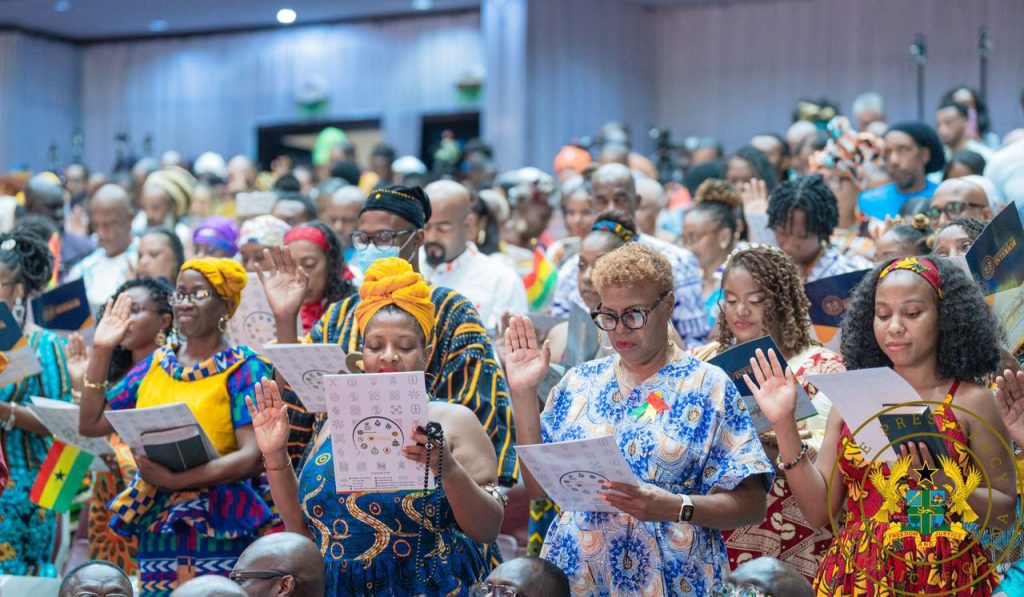
For the diaspora, perhaps the most significant early signal from the new administration came in December 2025, when Mahama hosted a Diaspora Summit in Accra under the theme “Resetting Ghana: The Diaspora as the 17th Region.” Speaking before an audience that included Ghanaian community leaders from North America, Europe, and beyond, Mahama made an explicit case for the diaspora’s centrality to Ghana’s future. He cited the staggering figure of $7.8 billion in remittances that Ghanaians abroad sent home in 2025 alone — a record — as evidence of a community that is already investing deeply in the nation’s wellbeing.
“Let’s take the narrative of those who oppressed us and work it,” Mahama told the summit. “In fact, let’s take their entire modus operandi and flip it and reverse it.” The speech was seen by many diaspora advocates as a declaration of intent — that this administration intends to treat Ghanaians abroad not as an afterthought, but as stakeholders with a genuine role in shaping the nation’s direction.
In his 2026 State of the Nation Address, Mahama declared that “the era of crisis management is over; the era of industrial execution has begun.” While much of the speech focused on macroeconomic achievements — including a dramatic drop in inflation and GDP growth of 6.1 percent through 2025 — his administration has also signalled its intent to move on long-delayed structural reforms, including those affecting the diaspora.
The Dual Citizenship Bill: A New Opening?
Simultaneously, Ghana’s Parliament is actively debating a constitutional amendment that could directly affect the political standing of diaspora Ghanaians: a bill to allow dual citizens to hold certain categories of public office. The legislation, which failed to pass during the previous Parliament before it dissolved, has been re-tabled in the current session and has already generated significant debate on the floor of the House.
During debate on the bill, one Member of Parliament captured the philosophical core of the issue: “The mere fact that a person has moved from Ghana to another country or picked citizenship from another country does not mean the person has lost his original citizenship or where he was born.” Several legislators made explicit reference to the enormous financial contributions of diaspora Ghanaians, questioning the fairness of a system that welcomes their remittances but restricts their political participation.
Another parliamentarian, speaking in support of the bill, invoked the legacy of Ghana’s founding father: “Research and data available from the World Bank, Bank of Ghana and other financial institutions show that the remittances that come to this country, the amount of financial contributions our diasporans make to this country is unimaginable… so how on earth do we accept all these remittances and support, yet when it comes to ensuring their rights to participate in our local governance structure, we tend to discriminate against them?”
The bill specifically seeks to amend Article 8 of Ghana’s Constitution to open certain public offices to dual citizens — a change that would have significant implications not only for political participation but for the entire ecosystem of diaspora engagement. Whether it will be extended to address the implementation of ROPAA and actual voting rights remains to be seen, but legislators from both sides of the aisle have acknowledged that the dual-citizenship and diaspora-voting questions are inseparable.
What This Means for Ghanaian-Canadians
Canada is home to one of the most active and politically engaged Ghanaian diaspora communities in the world. Concentrated in cities like Toronto, Ottawa, Calgary, and Vancouver, Ghanaian-Canadians have long organised around political issues — both domestic Canadian concerns and the affairs of their homeland. For this community, the failure to implement ROPAA is personal.
Many arrived in Canada as students, professionals, or refugees who, despite decades abroad, have maintained deep ties to Ghana. They send money home regularly — to support families, fund education, invest in small businesses, and contribute to community development projects. They follow Ghanaian politics closely, debate electoral outcomes over jollof rice at community gatherings, and campaign passionately on social media. But on election day itself, they are spectators, not participants.
Community leaders in Toronto have described the situation as a fundamental contradiction — a democracy that asks for financial investment but withholds political rights. “Clearing the passport backlog is one thing,” one diaspora representative was quoted as saying in reference to administrative improvements under the Mahama government, “but we are waiting to see if the measures provide the actual security and infrastructure needed for us to move our businesses back for good.” The same logic applies to voting: symbolic gestures are welcome, but the community wants legislative substance.
For Ghanaian students currently pursuing degrees at Canadian universities — the University of Toronto, York University, McGill, the University of British Columbia — the issue is even more acute. Many are here for two to four years, intend to return to Ghana, and yet will have zero say in who governs the country they plan to call home. Some have organised petition drives; others have joined advocacy groups such as aRTICLE 42, which takes its name directly from Ghana’s constitutional provision guaranteeing the right to vote.
The Global Precedent: Other Countries Have Done It
Ghana’s situation is not unique in Africa or the world, but its prolonged failure to act stands out when compared to peer nations. Across the globe, dozens of countries have successfully implemented systems allowing their citizens abroad to participate in elections — through absentee ballots, embassy-based voting, postal voting, and increasingly, secure digital platforms.
During Ghana’s own 2024 election season, American students at universities in the United Kingdom were able to vote remotely using absentee ballots through the US Federal Voting Assistance Program. British students used postal votes. Georgian nationals abroad voted at their embassies. In each of these cases, the governments found a way to balance the logistical challenges of overseas voting with the democratic principle that citizenship should not expire at the airport gate.
Advocates argue that Ghana already has the infrastructure to begin the process. The Electoral Commission is a member of international electoral organisations that maintain established protocols for overseas voting cooperation. Ghanaian embassies and high commissions exist in most of the countries where large Ghanaian communities reside — including Canada, the United Kingdom, the United States, and Germany. The technology for biometric registration, which Ghana has used domestically, could be adapted for overseas deployment. The obstacles are not technical. They are political.
A Democratic Debt Long Overdue
Ghana has long been celebrated as a beacon of democratic stability in West Africa — a region increasingly troubled by military coups, authoritarian backsliding, and electoral violence. It has delivered eight successive peaceful transfers of power. Its judiciary, while imperfect, has ruled against governments on electoral matters. Its civil society is vibrant, its press relatively free, and its citizens deeply engaged with the political process.
And yet, this same democracy has allowed a fundamental question of electoral inclusion to languish for twenty years without resolution. More than three million of its citizens — contributing billions in economic resources, maintaining cultural ties, raising the next generation of Ghanaians in cities across the world — have been told, effectively, that their vote doesn’t count unless they can afford the plane ticket home.
As one advocate writing about the issue put it: “Ghanaians are Ghanaians. In any case, all political parties routinely visit places of Ghanaian concentration in the diaspora to solicit funds… However, I think the concern about Ghanaians abroad voting is genuine and has to be addressed seriously.” No time is better than now. Ghanaians abroad have wanted to vote since 1992. Parliament should enable them to do so.
The Mahama administration, with its parliamentary supermajority, its “17th Region” rhetoric, and a dual-citizenship bill already on the table, has the political tools to finally close this democratic gap. Whether it will summon the political will to use them — or whether 2026 will become yet another year of missed opportunity — is a question that millions of Ghanaians, from Accra to Toronto, are waiting to have answered.
“Officials from all parties have told Ghanaians abroad that they were committed to fulfilling the two main demands of the Ghanaian Diaspora: voting and dual citizenship. If the principle is right, then the time is right as well.”
— Ghanaian Diaspora Advocate, on the 20-year wait for ROPAA implementation
EDITORIAL NOTE: This article is an original, fully researched analysis piece based on verified published sources including the Parliament of Ghana, GhanaWeb, the Oxford Blavatnik School of Government, Freedom House, the U.S. Library of Congress, and GBC Ghana Online. No unverified or unconfirmed legislative claims have been presented as established fact. All attributions are drawn from publicly available documentation. GhanaianNewsCanada is committed to factual, community-centred journalism.
Written by: Ebenezer Adu-Gyamfi / Emmanuel Ayiku | GhanaianNewsCanada
Published: March 10, 2026 | © 2026 GhanaianNewsCanada