


By: Ebenezer Adugyamfi & Emmanuel Ayiku for GhanaianNewsCanada
30 OCTOBER 2026
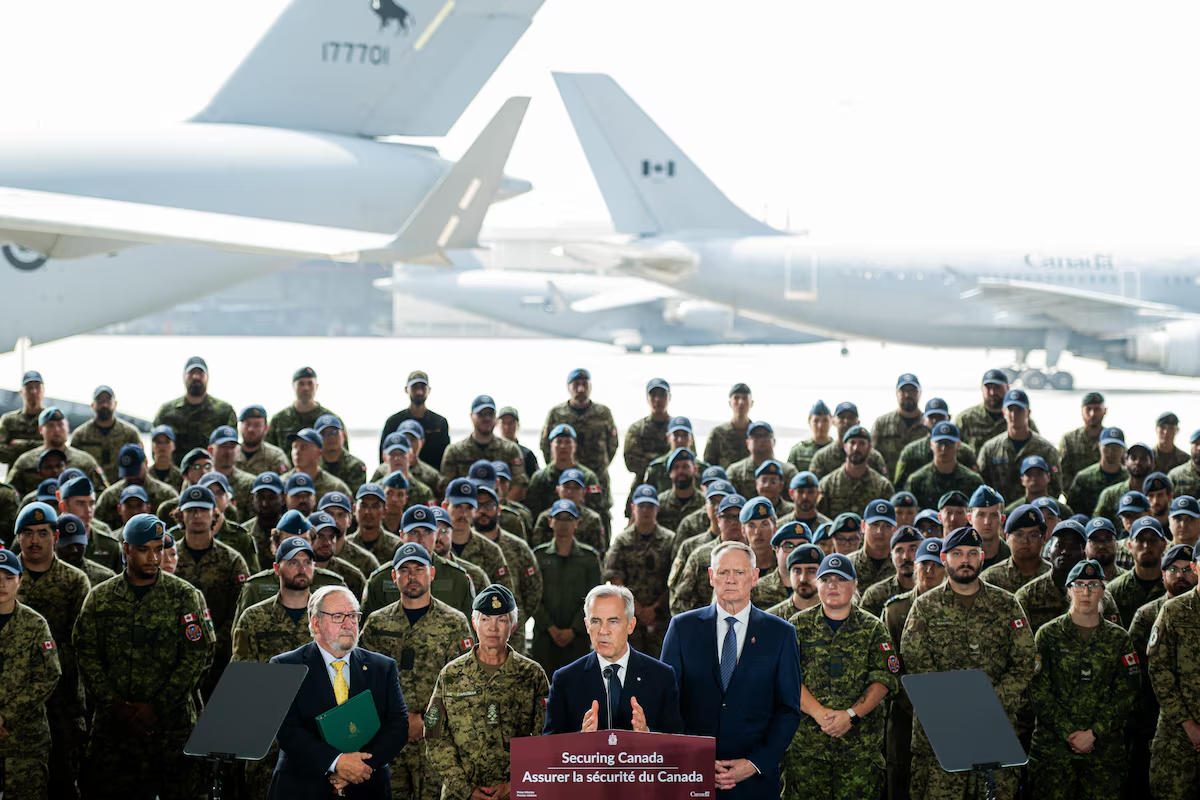
Canada has unveiled its first comprehensive national security strategy in more than two decades, with Prime Minister Mark Carney warning that the country must strengthen its ability to defend itself against an increasingly dangerous and unpredictable global environment.
The new strategy, titled The Plan for a Stronger Canada, was released on Thursday, October 29, 2026, marking a major shift in how the federal government intends to approach national security, economic resilience and the protection of Canadian sovereignty.
The document outlines an ambitious plan to strengthen Canada’s military, protect critical industries, improve intelligence capabilities, secure national borders and respond to emerging threats, including cyberattacks, foreign interference, espionage and organised crime.
It also signals a broader understanding of national security, placing economic independence and the protection of essential supply chains alongside traditional military defence.
According to the government, Canada can no longer rely solely on its geographical position, international relationships and longstanding security arrangements to protect its interests.
The strategy argues that the international order is changing, with growing geopolitical competition, authoritarian aggression and economic uncertainty creating risks that could directly affect Canada’s security and prosperity.
The government says the country must therefore develop stronger domestic capabilities while building partnerships with trusted international allies.
First national security strategy in more than 20 years
The release represents a significant development in Canadian security policy because the country had gone more than 20 years without publishing a comprehensive national security strategy.
The previous national security policy was introduced in April 2004 under former Prime Minister Paul Martin.
Since then, the global security environment has changed considerably, with the emergence of increasingly sophisticated cyber threats, international terrorism, geopolitical rivalries, foreign interference and growing competition over strategic resources.
The Carney administration argues that these developments require a coordinated government-wide approach that connects defence, economic policy, foreign relations, intelligence and public safety.
Rather than treating national security as primarily a military responsibility, the new strategy recognises that vulnerabilities in areas such as technology, energy, food production, pharmaceuticals and financial systems can also threaten national stability.
The government says the objective is to build a Canada capable of controlling its own future while remaining an active partner in international security arrangements.
Five major pillars of Canada’s new security strategy
The government’s plan is built around five interconnected areas that will guide its national security priorities.
1. Economic security
The strategy places economic security at the foundation of Canada’s national defence.
The government intends to protect and strengthen industries considered essential to the country’s long-term independence, including advanced manufacturing, critical minerals, energy, food production and emerging technologies.
It also plans to strengthen domestic supply chains, encourage Canadian investment and protect businesses and research institutions against foreign interference and economic espionage.
The government argues that a strong and resilient economy will give Canada greater freedom to make independent decisions and respond to international disruptions.
2. Foreign policy
Canada intends to diversify its international relationships and reduce its dependence on a limited number of economic and strategic partners.
The strategy identifies the importance of expanding cooperation with countries in Europe, the Indo-Pacific, the Middle East and Africa.
It also seeks to strengthen Canada’s ability to attract investment, expand exports and build international partnerships that support its national interests.
The government says diplomacy must increasingly support economic resilience and strategic independence.
3. Defence
The plan commits to rebuilding and modernising the Canadian Armed Forces.
Canada intends to improve its ability to defend its territory, protect its Arctic region and contribute to international security operations through partnerships such as NATO and NORAD.
The strategy also places emphasis on developing domestic defence industries so that the country can manufacture and maintain more of the equipment required by its military.
The government says Canada’s armed forces must be prepared to respond to modern threats, including hybrid warfare, cyber operations and challenges involving space-based systems.
4. Public safety
The strategy identifies foreign interference, espionage, violent extremism and transnational organised crime as important threats to Canadian society.
The government plans to strengthen border security, improve law enforcement capabilities and protect critical infrastructure.
It also intends to increase efforts against illegal firearms, drug trafficking, human smuggling, cybercrime, financial crime and money laundering.
Another priority is protecting Canadian institutions and communities from foreign information manipulation.
5. Intelligence
The final pillar focuses on improving Canada’s ability to collect, analyse and act on intelligence.
The government intends to strengthen the capabilities of the Canadian Security Intelligence Service (CSIS), the Communications Security Establishment (CSE) and defence intelligence agencies.
It also plans to make greater use of artificial intelligence and secure digital infrastructure to identify threats earlier and improve the speed of intelligence assessments.
Canada will continue working with its Five Eyes intelligence partners while seeking to expand cooperation with other countries.
Government prepares for possible war and worst-case scenarios
One of the most notable aspects of the new strategy is its explicit commitment to preparing Canada for all possible emergencies, including war.
The document states that the government must be ready for contingencies and worst-case scenarios rather than assuming that the country’s geographical position will automatically protect it from international conflicts.
This reflects growing concerns about geopolitical tensions, military aggression and the changing nature of modern warfare.
Canada’s Arctic region receives particular attention because of its strategic importance and the need to maintain a stronger and more permanent national presence.
The government also wants to improve its ability to respond to hybrid threats, which can combine cyberattacks, disinformation, economic pressure and other activities intended to weaken a country without conventional military confrontation.
The strategy does not announce that Canada is preparing to enter a specific war. Rather, it establishes preparedness for serious security emergencies as a central government responsibility.
Canada targets stronger military capabilities and increased defence spending
Rebuilding the Canadian Armed Forces is a major part of the government’s long-term security ambitions.
The strategy states that Canada invested an amount equivalent to 2 per cent of its gross domestic product in defence during the 2025–2026 fiscal year.
It also places the country on a path towards meeting NATO’s defence investment commitment of 5 per cent of GDP by 2035.
The government wants to expand Canada’s military capabilities, strengthen defence procurement and develop a stronger domestic industrial base capable of supporting the armed forces.
The plan also emphasises the importance of learning from recent conflicts, particularly the war in Ukraine, where developments in drone technology, cyber operations and modern battlefield systems have demonstrated how rapidly military capabilities are evolving.
Canada intends to develop more flexible military options to respond to conventional and emerging security threats.
Eight strategic sectors identified as essential to Canada’s future
Beyond the five pillars, the government has identified eight strategic capabilities it considers essential to national security and economic independence.
These include:
- Emerging technologies, including artificial intelligence, quantum computing and telecommunications.
- Critical minerals needed for advanced manufacturing and clean-energy technologies.
- Defence and military production.
- Energy security and reliable supplies.
- Transportation infrastructure and networks.
- Pharmaceuticals and biotechnology.
- Food security and domestic agricultural production.
- Payments, financial settlements and investment systems.
The government believes that weaknesses in any of these areas could expose Canada to economic disruption or pressure from foreign governments.
For example, dependence on foreign suppliers for essential medicines, semiconductors or advanced technology could become a serious problem during international conflicts or major supply-chain disruptions.
By strengthening domestic production and working with reliable partners, Canada hopes to reduce those vulnerabilities.
Stronger border protection and fight against organised crime
Public safety is another major component of the new strategy.
The federal government plans to strengthen border security through additional Canada Border Services Agency officers, modernised technology and improved intelligence sharing.
The strategy also identifies illegal firearms, drug trafficking, human smuggling and organised criminal networks as threats requiring stronger coordination between security agencies.
It further commits to strengthening Canada’s response to cybercrime, online exploitation, financial fraud and money laundering.
The government says it will work with provincial and territorial governments, Indigenous communities, municipalities and other institutions to improve national preparedness.
A First Ministers’ Meeting on National Security is also planned to improve coordination between federal, provincial and territorial governments.
Foreign interference and protection of democratic institutions
The strategy places considerable attention on foreign interference and attempts by outside actors to influence Canadian institutions.
The government intends to implement measures under the Foreign Influence Transparency and Accountability Act and establish stronger processes for reporting foreign interference incidents.
It also wants to improve cooperation between intelligence agencies, law enforcement, private businesses and research institutions.
These measures are intended to protect sensitive information, prevent espionage and strengthen public confidence in Canadian democratic institutions.
The strategy also recognises the growing threat of foreign information manipulation, particularly through digital platforms and emerging technologies.
Why the strategy matters for Canada’s international relationships
The new security plan comes at a time when Canada is seeking to strengthen its international relationships and reduce vulnerabilities associated with global economic dependence.
The government has identified Europe, the Indo-Pacific, the Middle East and Africa as important regions for expanding cooperation.
This approach could create opportunities for international partners interested in Canadian energy, critical minerals, agricultural products, advanced technology and defence industries.
For African countries, the strategy’s emphasis on diversifying trade and investment relationships could create opportunities for stronger economic engagement with Canada.
However, the government makes clear that international partnerships will increasingly be assessed according to how they contribute to Canada’s national interests, economic security and strategic capabilities.
This means that trade, investment and development relationships will form part of a broader national security calculation.
Strategy to be reviewed every four years
The federal government acknowledges that security threats continue to evolve and that its approach cannot remain unchanged for decades.
Under the new framework, Canada intends to update its national security strategy at least every four years.
The government also plans to review its national security institutions, legislation, intelligence structures and oversight arrangements.
It says modernising existing laws will be necessary to ensure that security agencies have the tools required to respond to emerging threats while protecting Canadians’ rights and freedoms.
Implementation will require cooperation across different levels of government, the private sector, Indigenous communities, research institutions and international partners.
Conclusion
Canada’s new national security strategy represents a major attempt to redefine how the country protects its sovereignty and prepares for an increasingly uncertain world.
By connecting economic security, defence, foreign policy, public safety and intelligence, the Carney government is seeking to build a more resilient country capable of responding to threats that extend beyond traditional military conflict.
The strategy also reflects a growing recognition that national security depends not only on the strength of a country’s armed forces but also on its ability to protect essential industries, maintain reliable supply chains, secure its borders and preserve the independence of its institutions.
Whether the ambitious commitments translate into stronger capabilities will depend on funding, implementation and cooperation between governments and the private sector.
For now, the message from Ottawa is that Canada intends to take a more active approach to protecting its national interests and preparing for a world in which economic and military security are increasingly connected.
