


By: Ebenezer Adu-Gyamfi / Emmanuel Ayiku For GhanaianNewsCanada | June 6, 2026 | Windsor / Detroit / Toronto
WINDSOR / TORONTO — Canada paid for it. Canada built it. Canada finished it. And now Canada cannot open it. That, in essence, is the extraordinary situation facing the Gordie Howe International Bridge — the $6.4 billion cable-stayed crossing that spans the Detroit River between Windsor, Ontario and Detroit, Michigan, and which federal briefing documents obtained by CBC News confirm has been “essentially complete” since February 2026. More than four months after construction finished, the bridge remains closed to traffic — trapped between a pending legal challenge, a missed contractor deadline, and the political demands of U.S. President Donald Trump.
The news, published by CBC News on Saturday June 6 based on newly obtained federal briefing documents, is both a testament to one of the most significant infrastructure achievements in Canadian history and a frustrating symbol of how Canada-U.S. relations under Trump have seeped into every corner of bilateral life — including a bridge that both countries spent two decades planning, designing, and constructing. As border policy researcher Laurie Trautman of Western Washington University put it bluntly to CBC: “Even in the best of times, it’s incredibly challenging. And then, in the worst of times — which I sort of would say we’re in now between Canada and the U.S. — it gets kind of ugly.”

What Is the Gordie Howe Bridge — and Why Does It Matter?
The Gordie Howe International Bridge — named after the legendary Canadian hockey icon known as “Mr. Hockey” — is a cable-stayed bridge that will eventually carry six lanes of vehicular traffic and a dedicated pedestrian and cyclist pathway across the Detroit River. It will connect Windsor, Ontario — Canada’s automotive capital and one of its most important industrial cities — directly to Detroit, Michigan, the historic heart of the American auto industry.
The Detroit-Windsor corridor is the busiest commercial border crossing in North America. Approximately $200 billion in goods crosses the Canada-U.S. border at this point every year — including automotive parts, manufactured goods, agricultural products, and consumer items that flow in both directions between the world’s largest bilateral trading relationship. The existing Ambassador Bridge, which opened in 1929 and is privately owned by the Moroun family of Michigan, handles the overwhelming majority of that traffic — and has been a source of controversy, congestion, and political conflict for decades.
The Gordie Howe Bridge was conceived as a publicly owned, publicly operated second crossing that would reduce dependency on the aging Ambassador Bridge, improve traffic flow, enhance border security, and create redundancy in the North American supply chain. Planning began in the early 2000s. Construction started in 2018. Canada agreed to cover the entire cost of the project — roughly $6.4 billion — with the understanding that tolls collected from users would eventually repay the investment. In June 2024, the two halves of the bridge deck extending from the Windsor and Detroit sides were joined over the middle of the river — a milestone celebrated on both sides of the border. Then the politics began.
Essentially Complete Since February — But Still Closed
The federal briefing documents obtained by CBC News reveal that the bridge reached “essentially complete” status in February 2026 — meaning the physical structure, the six-lane road deck, and the ports of entry on both sides were finished. What remained was a technical “testing and commissioning” phase in which every system on the bridge — electrical, mechanical, safety, communications, customs technology — must be verified as functioning properly and safely before the public is allowed to use it.
Phil Saoud, the vice-president and senior commissioning agent with Michigan-based engineering firm Peter Basso Associates whose team is responsible for testing every system on the bridge, has acknowledged the complexity of the commissioning process. His firm missed a May 1, 2026 deadline for completing its work — a delay that DHS Secretary Markwayne Mullin highlighted during a Senate Appropriations Committee hearing on June 2. Mullin confirmed that U.S. Customs and Border Protection staff are “good to go” and “ready to move” the moment authorisation is given — but that “there are still negotiations between Canada and the United States that have to be resolved” before the bridge can open.
The Windsor-Detroit Bridge Authority (WDBA), the Canadian Crown corporation responsible for managing the project, has repeatedly maintained that a spring 2026 opening was its target. Spring has now passed. No opening date has been announced. Navigation apps have reportedly been directing drivers to the bridge — where they arrive to find it still closed, sometimes with signs reading “Gordie Howe says: Open my bridge.”
Trump’s Intervention — ‘Canada Will Not Be Permitted to Proceed’
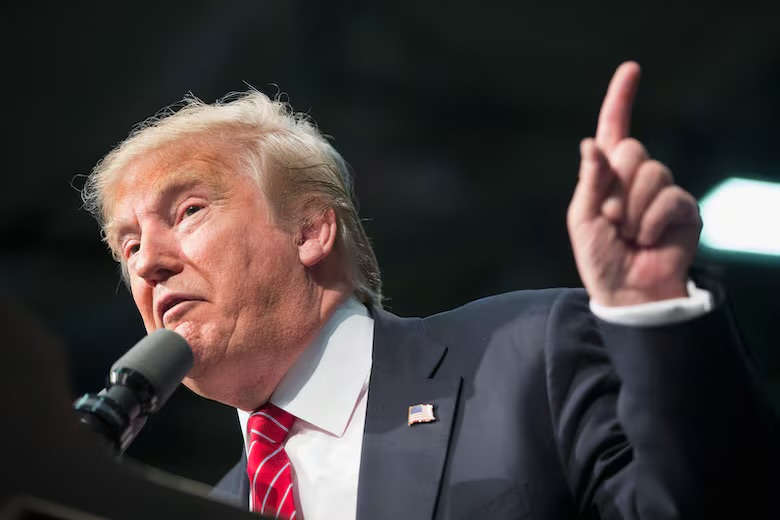
The most politically explosive element of the Gordie Howe Bridge story is what happened in February 2026 — almost simultaneously with the bridge reaching structural completion. U.S. President Donald Trump announced that the United States would not permit the bridge to open until Canada compensated Washington for what he described as “unfair treatment” by the Canadian government. Among Trump’s allegations was a claim that the project used only Canadian steel — a claim that was directly and publicly refuted by Canadian officials including Prime Minister Mark Carney.
Trautman, the border policy expert, called Trump’s intervention “pretty bizarre” — noting that the bridge was essentially finished, all major approvals had already been secured over years of bilateral negotiation, and the project had been planned and contracted under established Canada-U.S. infrastructure agreements. The White House, when pressed by reporters, pointed to what it called “longstanding unfair trade practices” by Canada as the basis for its demands — linking the bridge opening to the broader trade and tariff dispute that has defined Canada-U.S. relations since Trump returned to power.
Michigan Democrats have been particularly vocal about their frustration with the delay. Michigan Democratic Party Chair Curtis Hertel issued a public statement demanding Trump authorise the opening immediately: “The Gordie Howe Bridge is nearly finished and the Customs staff are ‘ready to go,’ and it’s well past time for Donald Trump and Republicans to quit playing political games and open this bridge, which is a game-changer for our economy.” The statement reflects a political reality that cuts across national lines: the bridge matters to Michigan businesses, workers, and communities just as much as it does to Windsor.
The Legal Challenge — A Court Case That Could Delay Things Further
Beyond Trump’s political demands, the bridge faces a separate and independently significant obstacle: a major legal challenge that is expected to reach trial later this year. The nature of the legal challenge — which involves the bridge contractor and relates to contractual disputes over the project — adds another layer of uncertainty to the opening timeline. The CBC report specifically notes that Canada finished building the bridge before this legal challenge reaches trial, meaning the structure was completed despite — not after — the resolution of outstanding legal disputes.
Windsor Mayor Drew Dilkens, who has been one of the most outspoken voices on the bridge’s delayed opening, has threaded a careful political needle on the question of how Canada should respond to U.S. demands. “I know that the U.S. government has put a proposition forward to the Canadian government on how they might find a pathway to open the bridge,” Dilkens told reporters. “What I’ve said is, if it’s a bad deal, don’t take it, Canadian government. I’d rather keep the Gordie Howe Bridge closed than accept a bad deal under Trump.” The statement captures the mood in Windsor perfectly: impatience with the delay, frustration with U.S. political interference, but a refusal to be pressured into an unfavourable agreement.
What This Means for Ghanaian-Canadians
For the Ghanaian-Canadian community — concentrated in cities across Ontario and beyond — the Gordie Howe Bridge story connects to issues that affect daily life in concrete ways. The Windsor-Detroit corridor handles a massive volume of cross-border trade that feeds into the supply chains of Canadian businesses, including the automotive sector that employs thousands of Canadians in Windsor, Brampton, Oakville, and surrounding communities. When goods take longer to cross the border, when supply chains face disruption, when trade costs rise — those effects ripple outward into employment, consumer prices, and economic stability.
More broadly, the Gordie Howe Bridge story is the latest chapter in the ongoing story of Canada’s relationship with its southern neighbour under Trump — a relationship that has been tested on tariffs, on the joint defence board suspension, on the 51st state rhetoric, and now on a bridge that Canada paid for entirely and that the U.S. is using as a bargaining chip. For a community of immigrants who chose Canada in part for its stability and its independent standing in the world, watching that independence be tested at every turn is unsettling — but also, perhaps, clarifying.
