


By: Ebenezer Adugyamfi & Emmanuel Ayiku for GhanaianNewsCanada
November 6, 2026
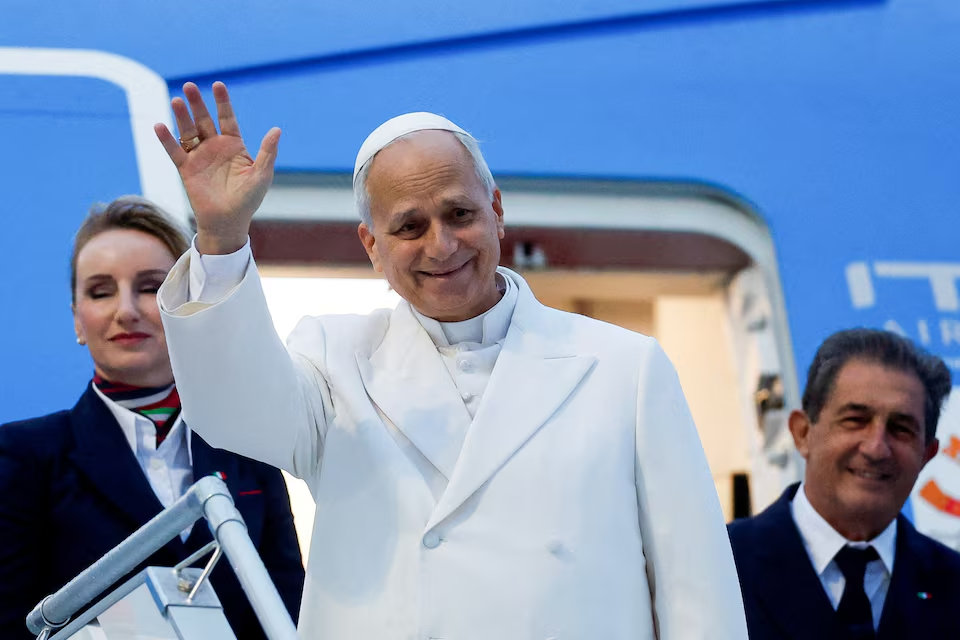
Pope Leo XIV has departed Rome for a major South American tour, returning to a region where he spent decades serving as a missionary and church leader, just weeks after undergoing surgery to remove a cancerous tumour from his lung.
The 71-year-old pontiff began the 12-day journey on Friday, November 6, with scheduled visits to Uruguay, Argentina and Peru. The trip will end on November 17 and is expected to cover approximately 31,000 kilometres across 10 cities.
The journey is particularly significant for the Chicago-born pope, who spent several years working in Peru, eventually becoming a citizen of the South American country before his election as pontiff in May 2025.
It is also one of the most demanding overseas trips undertaken by a Catholic leader in recent decades, involving numerous flights, helicopter journeys, public Masses, meetings with political leaders and engagements with local communities.
The Vatican has confirmed that the pope has recovered sufficiently from his October operation to proceed with the original itinerary, without additional medical arrangements beyond the usual medical support accompanying papal visits.
A major international trip following cancer surgery
Pope Leo underwent surgery on October 13 to remove the lower lobe of his right lung after being diagnosed with lung adenocarcinoma, the most common form of lung cancer.
The Vatican subsequently confirmed that the cancer was localised and that examinations of the removed tissue indicated he would not require further treatment.
His health became a major consideration ahead of the South American journey because of the demanding schedule, which includes long-distance air travel and visits to high-altitude communities.
Vatican spokesperson Matteo Bruni said the pope was in good health and did not require special medical precautions for the trip.
The medical personnel who normally accompany the pontiff will travel with him, while ambulances will remain part of the usual security and medical arrangements.
However, medical experts cited by Reuters have noted that high-altitude visits, particularly in Peru, could require careful management of fatigue and oxygen levels.
One of the scheduled destinations is Cusco, which sits approximately 3,399 metres above sea level.
Despite the medical considerations, the Vatican has maintained that the pope’s itinerary will proceed as planned.
Peru: A deeply personal homecoming
Among the three countries, Peru carries particular significance for Pope Leo.
Before becoming pope, Robert Francis Prevost spent many years in the country as an Augustinian missionary and later served in church leadership, including as bishop of Chiclayo.
His experiences in Peru played an important role in shaping his pastoral ministry and relationship with communities across Latin America.
The visit will allow him to reconnect with places and people associated with his earlier religious service.
According to the Vatican’s published programme, the pope will arrive in Peru on November 11 and remain until November 17.
His itinerary includes Lima, Chiclayo, Cusco and Pucallpa.
He is expected to celebrate Mass, meet local church communities, visit remote areas and engage with Indigenous communities in the Andes and Amazon regions.
The Peru leg is expected to be one of the most emotionally significant parts of the journey, given the pope’s long-standing connection to the country.
Argentina visit carries political and religious significance
Pope Leo will travel to Argentina from November 8 to November 11, visiting Buenos Aires, Córdoba and Luján.
The visit is particularly important because Argentina was the homeland of his predecessor, Pope Francis, who died in April 2025.
Leo’s visit will also bring him into contact with President Javier Milei, whose economic policies and approach to government spending have generated significant debate in the country.
The pope’s engagements are expected to provide opportunities to address poverty, economic hardship, social inequality and the responsibilities of political leadership.
His visit comes at a time when Argentina is experiencing significant economic and social challenges, making the Church’s engagement with vulnerable communities an important part of the programme.
The journey also carries historical significance because Argentina has not received a papal visit since Pope John Paul II travelled there in 1987.
Uruguay opens the 12-day journey
Uruguay is the first destination on the pope’s itinerary.
He is scheduled to remain in the country from November 6 to November 8, visiting Montevideo, Paysandú and Florida.
The visit is notable because Uruguay is among the most secular countries in Latin America, despite the region’s historical association with Catholicism.
The Vatican has described the journey as an opportunity to strengthen relationships with Catholic communities and bring the Church’s message to people across different social and religious backgrounds.
It will also be the first papal visit to Uruguay since Pope John Paul II travelled there in 1988.
The opening stage of the tour is expected to focus on faith, unity, community engagement and the Church’s role in contemporary society.
Catholicism faces declining identification in Latin America
The pope’s return to South America comes at a time when the Catholic Church is confronting changes in religious affiliation across the region.
Latin America remains home to the world’s largest Catholic population in absolute numbers. However, research has shown a gradual decline in the proportion of people identifying as Catholic in several countries.
A 2024 Pew Research Center survey covering six of the region’s most populous countries found that Catholic identification had declined compared with a decade earlier.
The findings also highlighted the growing presence of evangelical Protestant churches and the increasing number of people who no longer identify with a religious institution.
For the Vatican, the tour presents an opportunity to reconnect with communities, strengthen the Church’s presence and address the concerns of Catholics and non-Catholics alike.
The challenge is not simply maintaining religious membership but demonstrating the Church’s relevance in societies experiencing economic, cultural and political changes.
Pope expected to address social justice and environmental concerns
Beyond religious ceremonies, the itinerary includes engagements that reflect some of the major social challenges confronting South America.
The pope is expected to address issues including environmental destruction, poverty, arms trafficking, political instability and the treatment of vulnerable communities.
His programme also includes encounters with prisoners, visits to communities affected by environmental pressures and meetings with local church leaders.
The Vatican has confirmed that Pope Leo will also meet victims of clerical sexual abuse during the journey.
Such engagements are significant as the Catholic Church continues to face scrutiny over its handling of abuse allegations and the need for accountability and support for survivors.
The pope’s public statements during the visit will be closely followed by religious communities, political leaders and international observers.
A defining journey for Pope Leo’s leadership
The South American tour represents an important moment in Pope Leo XIV’s pontificate.
It is his first major return to Latin America as pope and an opportunity to revisit communities that played a significant role in his development as a religious leader.
The journey also comes at a time when the Catholic Church is navigating declining affiliation in parts of the region, political divisions and demands for greater accountability.
While his recent surgery has drawn attention to the physical demands of the trip, the Vatican has maintained that he is fit to undertake the programme.
As Pope Leo travels through Uruguay, Argentina and Peru, the visit will test the reach of his message of faith, peace, social responsibility and unity across a region with which he shares a deep personal connection.
