By: Ebenezer Adu-Gyamfi / Emmanuel Ayiku For GhanaianNewsCanada | June 12, 2026 | Mexico City / Toronto

🇲🇽 MEXICO 2 – 0 SOUTH AFRICA 🇿🇦
Julián Quiñones 10′ | Raúl Jiménez 67′
🟥 Sphephelo Sithole (SAF, 52′) | 🟥 Themba Zwane (SAF, 78′) | 🟥 César Montes (MEX, 81′)
Estadio Azteca (Banorte), Mexico City | Thursday June 11, 2026 | FIFA World Cup Group A
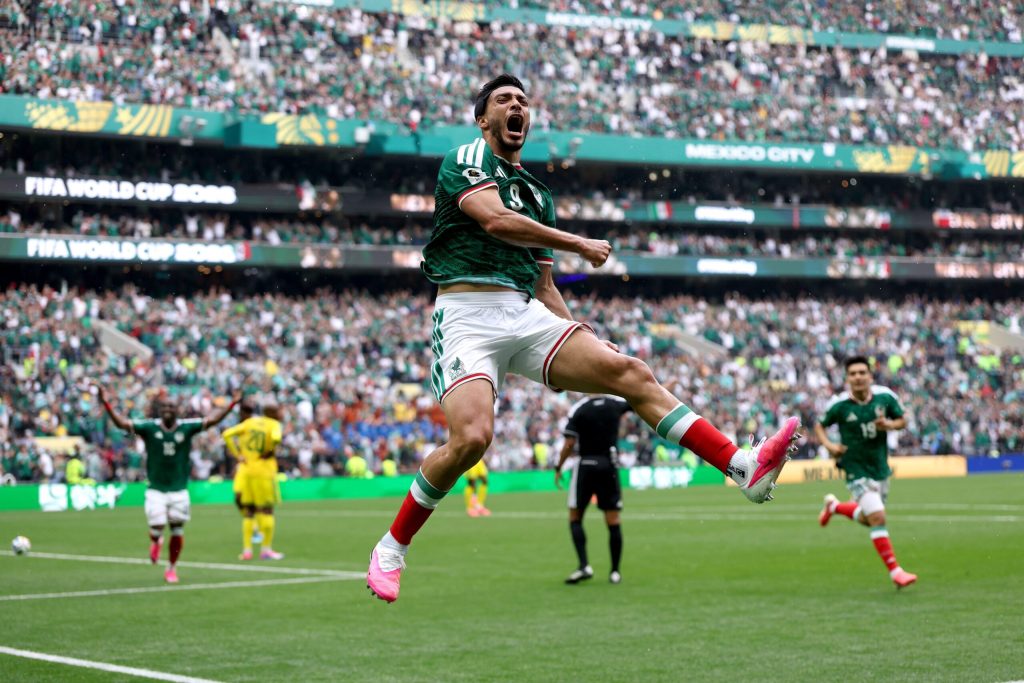
MEXICO CITY / TORONTO — The wait is over. The 2026 FIFA World Cup is officially here — and it arrived at the most iconic football stadium in the Americas with all the drama, colour, and chaos that the world’s greatest sporting event has always promised. On Thursday evening in Mexico City, in front of a sold-out Estadio Azteca that roared with 87,000 fans dressed in green, the co-hosts Mexico defeated South Africa 2-0 in the tournament’s opening match — a game that featured two crisp goals, a stunning opening ceremony with Shakira and Andrea Bocelli, and the most remarkable disciplinary record in World Cup opening game history: three red cards.
The Estadio Azteca has now hosted three World Cup opening matches — 1970, 1986, and now 2026 — making it the only stadium in history to achieve that feat. And the building, which has witnessed so many of football’s greatest moments across its six decades, did not disappoint in delivering an atmosphere worthy of the occasion. For Ghana, watching from here in Toronto as their own World Cup journey begins today, the images from Mexico City were a preview of the global festival that has now arrived on this continent.

Before the Ball Kicked — Shakira, Bocelli and a Ceremony to Remember
Before a single ball was kicked, the 2026 World Cup delivered a spectacle of its own. The opening ceremony at the Estadio Azteca was a three-continent cultural showcase, featuring performances by Colombian superstar Shakira — returning to the World Cup stage for the first time since her iconic 2010 Waka Waka performance that became one of the most viewed World Cup moments in history — Italian tenor Andrea Bocelli, and Colombian reggaeton artist J Balvin.
The ceremony was the first of three planned opening events across the three host nations — with separate ceremonies planned for the United States and Canada as the tournament progresses. FIFA’s decision to spread the ceremonial moments across all three co-hosts was a deliberate acknowledgment that this is a World Cup unlike any other: the first to involve 48 teams, the first to be shared across three countries, and the first in North America since 1994.
The Match — Quiñones Opens, Jiménez Seals It, Red Cards Erupt
Mexico coach Javier Aguirre — who also managed El Tri in the 2010 World Cup when the two teams last met in the opening game and drew 1-1 — will have been relieved by the composure his team showed in the early stages. The Azteca crowd, electric from the first whistle, got what it wanted in the 10th minute when Julián Quiñones broke the deadlock.
The goal was well worked — a slick combination that cut through South Africa’s defensive shape and allowed Quiñones to finish crisply. It was exactly what Mexico needed: an early goal to settle the crowd, settle the team, and put the pressure firmly on the visitors.
South Africa — returning to the World Cup for the first time since hosting the 2010 tournament where they became the first and only host nation to be eliminated at the group stage — showed glimpses of the resilience that coach Hugo Broos has built into the team. Bafana Bafana finished third at the last Africa Cup of Nations and topped a qualifying group that included Nigeria. They were not here to make up the numbers.
But the contest changed fundamentally in the 52nd minute when South Africa’s Sphephelo Sithole received a straight red card — a stonewall sending off for pulling back a Mexican attacker who was clear through on goal. The referee had no choice. South Africa were down to 10 men with nearly 40 minutes still to play.
Raúl Jiménez capitalised 15 minutes later. The veteran Mexican striker — who had waited his entire career for this moment — scored his first-ever FIFA World Cup goal in the 67th minute, finishing confidently to make it 2-0. It was a deeply emotional moment for the 33-year-old, who suffered a horrific skull fracture while playing for Arsenal in November 2020 and whose long road back to elite football culminated in scoring at the Azteca in a World Cup.

The drama was not finished. In the 78th minute, South Africa were reduced to nine men when substitute Themba Zwane received a second yellow card — a reckless challenge that left Bafana Bafana’s remaining players with the near-impossible task of surviving the final twelve minutes with two fewer players than the opposition. Three minutes later, Mexico’s own César Montes was shown a straight red card for a dangerous foul — meaning both teams will be without key players for their next group games. Three red cards in a single World Cup match is a record, and it happened in the very first game of the tournament.
Mexico’s 16 total shots produced 4 on target. South Africa, for all their numerical disadvantage in the second half, showed moments of quality and fight that suggest they will not be easy opponents for South Korea and Czechia in the games ahead. But the result was clear and deserved: Mexico 2, South Africa 0. The hosts had their opening three points.
The Significance — A Rematch 16 Years in the Making
The fixture carried a weight of history that made it particularly meaningful for both sets of supporters. In June 2010, the very first match of the South Africa-hosted World Cup was also Mexico vs South Africa — and it ended 1-1, with Siphiwe Tshabalala’s thunderous opening goal becoming one of the most celebrated strikes in African football history. That moment, in front of a rapturous Johannesburg crowd, encapsulated the spirit of the first World Cup held on African soil.
Sixteen years later, the fixture was reversed — Mexico as hosts, South Africa as visitors — in a rematch that FIFA’s scheduling department had clearly arranged with narrative intent. The first World Cup in North America since 1994. The first 48-team World Cup. And for its opening act: a repeat of the 2010 opener, sixteen years on. Football does not always deliver on its promises of drama and history. On Thursday in Mexico City, it delivered in full.
What Happens Next — Group A and the Road to the Knockouts
Mexico’s opening win puts them in a strong early position in Group A, though the celebrations must be tempered by the loss of key centre-back César Montes to suspension for the next game. El Tri face South Korea in Guadalajara on June 18 — a significantly more demanding test against a tactically sophisticated Asian side led by Son Heung-min, likely in his final World Cup. The two teams played to a 2-2 draw in their most recent encounter in September 2025.

South Africa, meanwhile, must regroup quickly while absorbing the losses of Sithole and Zwane to suspension. Their June 18 opponent is Czechia — who yesterday in Guadalajara lost 2-1 to South Korea after leading at half time — meaning both South Africa and Czechia arrive at that fixture needing a result to keep their knockout round hopes alive.
🇬🇭 TODAY IS GHANA DAY — The Black Stars Kick Off at BMO Field!
As thrilling as Mexico’s opening night was, for Ghanaian-Canadians in Toronto the biggest story of this World Cup begins TODAY. Ghana vs Panama at BMO Field in Toronto — the Black Stars’ Group L opener — kicks off at 3pm ET on Thursday June 12. The same Estadio Azteca electricity that lit up Mexico City last night is coming to Toronto this afternoon.
Thousands of Ghanaian-Canadians will fill BMO Field — many wearing the Black Stars’ white and gold jersey, many more wrapped in the Ghanaian flag. For a community that has waited decades for this moment — to watch Ghana play at a World Cup, in their adopted home city, on Canadian soil — today is one of the most extraordinary days in the history of the Ghanaian-Canadian community.