


By: Ebenezer Adugyamfi & Emmanuel Ayiku for GhanaianNewsCanada
26 OCTOBER 2026
Kinew tells Prime Minister Mark Carney the legislation has outlived its purpose, as Indigenous leaders raise concerns over land rights, economic development and the future of First Nations governance.
Manitoba Premier Wab Kinew has called on the federal government to abolish Canada’s Indian Act, arguing that the century-old legislation no longer reflects the country’s modern relationship with Indigenous peoples.
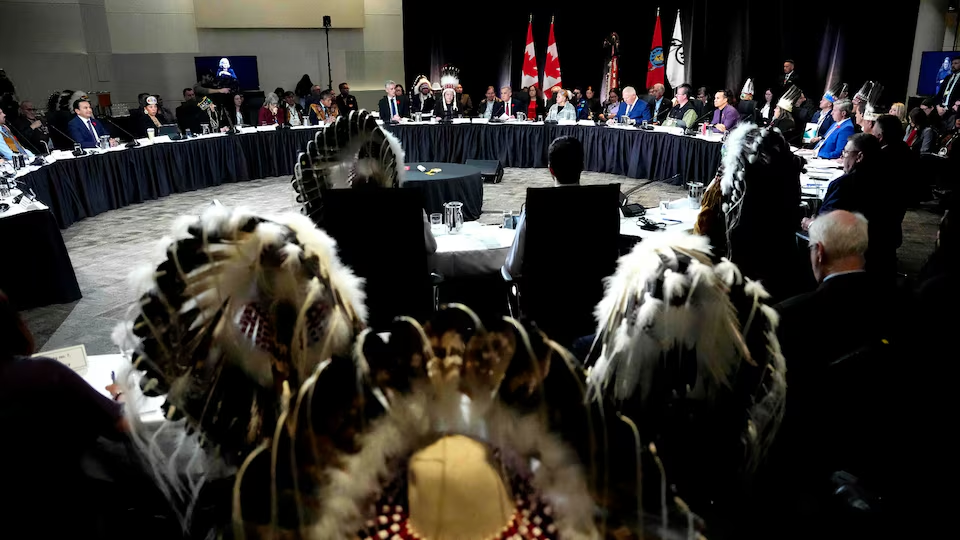
Kinew said he raised the issue directly with Prime Minister Mark Carney during a historic meeting in Ottawa on Monday, October 26, involving federal and provincial leaders and First Nations chiefs.
Speaking to reporters during a break in the discussions, Kinew held up his First Nations status card, which identifies him as an “Indian within the meaning of the Indian Act.”
The Manitoba premier argued that Canada should move away from what he described as a race-based system of identification and develop a more modern approach to its relationship with Indigenous communities.
“It’s time to abolish the Indian Act,” Kinew said, according to reporting by The Canadian Press.
His comments add to a broader national debate about Indigenous rights, self-government and the role of federal legislation in determining how First Nations communities are recognised and administered.
What is the Indian Act?
The Indian Act is a federal law enacted in 1876 that governs many aspects of the relationship between the Canadian government and First Nations people registered under the legislation.
Over its history, the law has regulated matters including Indian status, reserve lands, band governance and certain administrative affairs of First Nations communities.
The legislation has long been criticised for its colonial origins and for giving the federal government extensive authority over Indigenous peoples and their communities.
Historically, it was also used to impose assimilationist policies that restricted Indigenous cultural practices and autonomy. Although successive governments have amended the legislation, critics argue that its underlying framework continues to limit self-determination.
The Act does not apply in the same way to all Indigenous peoples in Canada. Inuit and Métis peoples have different legal and constitutional circumstances, and First Nations communities themselves have diverse treaty arrangements and governance systems.
Kinew’s call to abolish the law therefore raises a fundamental question: what legal and administrative framework should replace it, and how can that transition protect the rights and interests of Indigenous peoples?
Kinew argues for a modern relationship
Kinew’s remarks reflect calls for Canada to move towards a relationship with Indigenous peoples based more firmly on recognition, partnership and self-government.
By questioning the continued use of the Indian Act’s status-based identification framework, the premier highlighted concerns about how the federal government defines and administers Indigenous identity.
However, abolishing the Act would involve more than eliminating a statute. The law currently provides legal rules governing matters such as reserve lands, registration and band administration.
Any replacement would need to address those functions while ensuring that First Nations communities do not lose existing rights, protections or access to services.
Indigenous leaders and communities would also need a meaningful role in shaping the changes, particularly because the implications could differ substantially depending on their treaties, governance arrangements and priorities.
Meeting brings First Nations leaders and governments together
Kinew made his remarks during a gathering involving Carney, provincial premiers and chiefs from the Assembly of First Nations.
The meeting was notable because it brought together First Nations leaders and first ministers for the first such gathering since the discussions associated with the 2005 Kelowna Accord.
Those earlier talks, convened under former prime minister Paul Martin, sought to address socioeconomic disparities affecting Indigenous communities through investment in areas such as education, healthcare, housing and economic development.
The agreement was not implemented following the subsequent change in federal government.
Assembly of First Nations National Chief Cindy Woodhouse Nepinak has said the current meeting is intended to help build prosperity for future generations.
The gathering comes as the Carney government pursues legislation and policies designed to accelerate major infrastructure and resource projects. Some Indigenous leaders have warned that shorter approval timelines could threaten their rights if governments fail to provide meaningful consultation.
The debate over the Indian Act adds another important dimension to the discussions, placing Indigenous governance and self-determination alongside economic development.
Replacing the Act would require careful consultation
Although Kinew has called for the legislation to be abolished, the meeting has not established that the federal government has agreed to repeal it.
Abolition would require a clear transition plan and legislation addressing the responsibilities currently governed by the Act.
Such a process would need to consider the protection of reserve lands, the recognition of First Nations governments, eligibility for registration and the continuation of public services and legal rights.
There is also an important distinction between abolishing the Indian Act and eliminating the constitutional rights of Indigenous peoples. First Nations rights recognised and affirmed under Section 35 of Canada’s Constitution Act, 1982, exist independently of the Indian Act and would not automatically disappear if the statute were repealed.
The challenge for federal and Indigenous leaders would be to develop a system that supports self-determination without creating uncertainty over rights, land ownership, governance or access to services.
Different First Nations may also favour different arrangements, making consultation essential to any reform process.

Indigenous voices remain central to the debate
The wider discussions in Ottawa have also exposed disagreements over who speaks for Indigenous communities and how their interests should be represented in national decisions.
Some activists have argued that young people and grassroots community members need a stronger voice, particularly on projects affecting Indigenous territories and future generations.
Others support economic development when communities are meaningfully involved and can benefit through employment, investment and ownership opportunities.
These differences underline the complexity of developing a national approach that respects the diversity of First Nations communities.
For Kinew, abolishing the Indian Act would represent a significant change in Canada’s relationship with Indigenous peoples. The practical impact, however, would depend on the legal framework that replaces it and the extent to which First Nations communities help shape that framework.
What happens next?
Kinew’s call has placed the future of the Indian Act firmly on the agenda of discussions about Indigenous rights and Canada’s constitutional relationship with First Nations.
The prime minister and provincial leaders have not, based on the available reporting, announced an agreement to abolish the legislation.
For now, the proposal remains a political call for fundamental reform rather than a confirmed federal policy decision.
Any meaningful change would require detailed negotiations, legislative work and extensive engagement with affected Indigenous communities.
As discussions continue, the central question will be whether Canada can move beyond a framework rooted in colonial administration towards arrangements that recognise Indigenous self-government while protecting existing rights and legal certainty.
The debate is likely to remain an important part of Canada’s wider conversation about reconciliation, economic development and the future of relations between Indigenous peoples and the Crown.

