
Iran Says It Will Not Surrender to U.S., but Calls for Diplomacy at UN
President Masoud Pezeshkian tells world leaders that Tehran will resist military pressure while remaining open to negotiations to end the conflict with the United States.

By: Ebenezer Adugyamfi / Emmanuel Ayiku for GhanaianNewsCanada September 23, 2026
Iranian President Masoud Pezeshkian has declared that Tehran will not surrender in its ongoing war with the United States, while insisting that diplomacy remains the only path to lasting peace.
Addressing the 81st United Nations General Assembly in New York on Wednesday, Pezeshkian accused U.S. President Donald Trump of using threats and intimidation instead of genuine dialogue. He said Iran would resist pressure but remained willing to negotiate an end to the conflict.
“Iran will not bow to pressure”
In one of the strongest speeches delivered by an Iranian leader during the current conflict, Pezeshkian rejected Trump’s warning that the United States could “annihilate” Iran if no agreement is reached.
He told the 193-member General Assembly that the Iranian people would not surrender to what he described as a “bullying mentality,” arguing that military threats only strengthen Tehran’s resolve.
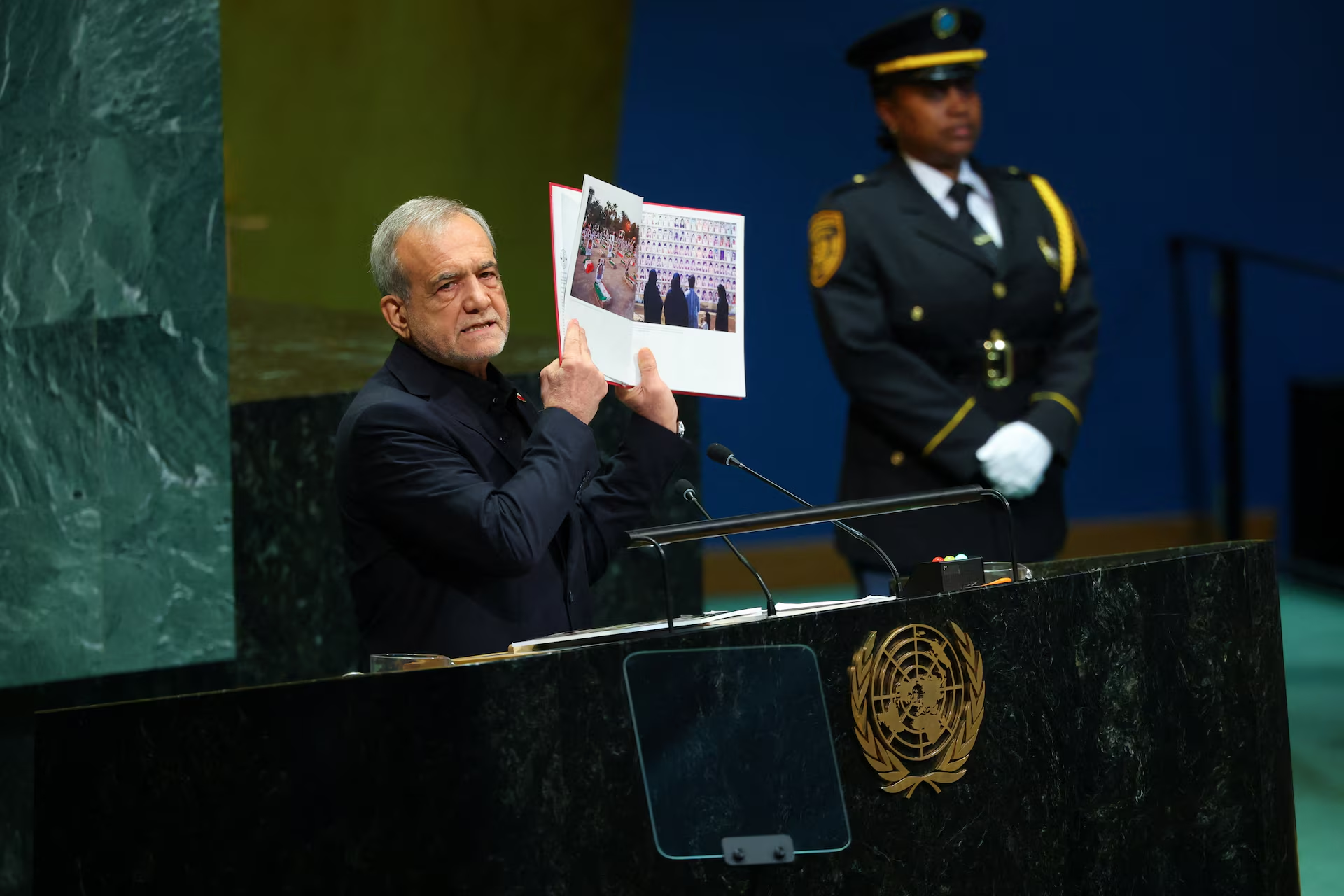
The speech came just one day after Trump defended the U.S. military campaign against Iran during his own UN address and claimed a peace agreement could soon be within reach.
U.S. delegation walks out
Tensions inside the UN chamber became immediately visible as the United States delegation walked out at the beginning of Pezeshkian’s speech.
The U.S. mission to the United Nations did not immediately comment on the walkout, according to Reuters.
Pezeshkian opened his address by accusing the United States of killing civilians during the war and held up photographs that he said showed victims of the conflict, including schoolchildren. Those claims reflect Iran’s position and have not been independently verified in the Reuters report.
Strait of Hormuz remains central issue
The Iranian president also focused on the Strait of Hormuz, one of the world’s most strategically important shipping routes.
Before the war, roughly one-fifth of global oil and liquefied natural gas exports passed through the narrow waterway. Pezeshkian argued that Iran could not accept a situation where other nations benefit from the strait while Iranian shipping faces restrictions.
He warned that the continued deployment of hostile naval forces and the expansion of the war would not bring peace to the region.
Diplomacy still possible despite deep divisions
Despite his defiant tone, Pezeshkian repeatedly emphasized that Iran remains committed to diplomacy.
A senior Iranian official told Reuters that Tehran and Washington are still far apart on the conditions for ending the war, but both sides believe negotiations must continue.
The conflict has now become one of the dominant issues at this year’s UN General Assembly, alongside wars in Ukraine and the broader Middle East. Diplomats continue to monitor whether renewed contacts between Iran and the United States can produce a ceasefire or a broader peace agreement.


