
Poilievre warns Carney: Canada must not make unilateral concessions in Trump trade deal
By: Ebenezer Adugyamfi/ Emmanuel Ayiku for GhanaianNewsCanada
August 19, 2026
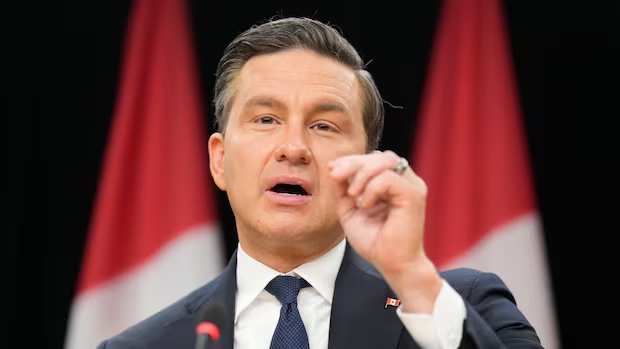
Conservative Leader Pierre Poilievre has urged Prime Minister Mark Carney to ensure that any new trade agreement with U.S. President Donald Trump does not require Canada to make unilateral concessions.
Poilievre’s warning comes as Canadian and American officials race to finalize a trade agreement following Trump’s decision to temporarily pause a planned 50% tariff on certain Canadian goods.
Trump announced a three-day delay after claiming that Washington and Ottawa had reached a preliminary agreement, although Canadian officials have stressed that important details remain unresolved.
Speaking as negotiations entered a critical stage, Poilievre said Canada should not give up important economic interests without receiving meaningful benefits in return.
His position puts additional political pressure on Carney’s Liberal government as it attempts to secure better access for Canadian exports while protecting key domestic industries.
Poilievre calls for a balanced agreement
The Conservative leader’s message is that any concessions made by Canada must be matched by concrete gains from the United States.
The warning comes after months of difficult negotiations between Ottawa and Washington, with tariffs on Canadian products already affecting sectors including automobiles, steel, aluminum and forestry.
The latest negotiations have focused on reducing some of those tariffs while addressing American demands for greater access to Canadian markets.
One of the major unresolved issues involves Canada’s supply-management system, particularly the dairy sector. Trump has criticized Canada’s policies as unfair to American producers, while the Canadian government has maintained that it must protect the country’s agricultural interests.
Three-day tariff pause
The political debate comes as the clock runs down on Trump’s temporary suspension of the new 50% tariffs.
The proposed tariffs were expected to affect about $20 billion worth of Canadian goods, increasing concerns among Canadian businesses and exporters.
Canadian negotiators have returned to Ottawa to work on the final details of the agreement.
Among the outstanding issues is the tariff applied to Canadian automobiles. Canada is seeking a reduction from the current 25% level to 10%, while the U.S. has reportedly proposed a 15% rate.
Carney says progress has been made
Prime Minister Mark Carney has acknowledged that substantial progress has been made in negotiations but has cautioned that the agreement is not yet finalized.
The government is seeking to preserve Canada’s favorable trading relationship with the United States while also securing improved conditions for major Canadian industries.
The three-day extension gives both sides additional time to settle outstanding issues, but the pressure remains high.
If a final agreement is not reached before the deadline, the threatened tariffs could return, potentially creating further uncertainty for businesses and consumers on both sides of the border.
For Poilievre and the Conservatives, however, the negotiations are also about ensuring that Canada does not sacrifice its economic interests simply to avoid tariffs.
The coming days could therefore prove crucial for Carney’s government as it seeks to strike a deal with Trump while facing growing political pressure at home.


